

Why I made my son and daughter watch multiple videos of Ryan Coogler at the Oscars
It should not be this novel: to see a famous man on our screens, so clearly in love with others

“You all, check this out,” I called, iPad in hand. “Is it something fun?” my daughter replied, a question that I should have anticipated.
“I mean, I think so,” I stammered, “just trust me, I need to show you this guy. He’s a dad I really respect.”
Bless them, my children, for humoring my minimally compelling paternal sales pitches. We had a snow day yesterday, a spring blizzard, so they were a temporarily captive audience.
The dad in question, of course, was Academy Award winning director Ryan Coogler. I don’t know him, but I suspect he’d appreciate the honorific.
Actually, let’s pause there. I truly don’t know Ryan Coogler, a human being who seems damned cool, but who knows? Maybe he’s not so hot, in real life. Maybe, like me, he annoys his spouse by leaving the cupboards open when he’s cooking. Maybe he’s just really good at a very specific public presentation of self.
But also, I hear the way Coogler talks about the people he adores, and the way they talk about him, and my goodness. You could do worse. I am raising two kids, after all, a nine year old girl and a boy just a couple months away from officially being a teenager. My daughter reports that, in her third grade classroom, the boys play “Youtube” on the playground, each taking on the persona of some flashy, tough talking influencer bro. My son is aware of the influencers too, but more frighteningly, he’s aware of the actual news. He’s had to hear Pete Hegseth utter the phrase “maximum lethality, not tepid legality” while grinning like a schoolyard bully.
You do what you can, as a parent, in a world where boys and girls alike are asked to accept boorish men as either role models or necessary evils. And yesterday, what I had to offer was clips of a man who seems worthy of their attention.
Here’s what I’ve noticed about Ryan Coogler, in public speeches and profiles. He always positions himself in context, not just of other people, but their stories: His parents’ stories, his uncle and grandparents’ stories, his wife and kids’ stories, the stories of his colleagues and friends and their children, the stories of American Blackness, the stories of the East Bay. Whenever he talks, he sounds like he’s picturing himself cradled in a web of humanity.
This is love, I believe. Ryan Coogler loves, and not merely rhetorically: women, his parents and extended family, his wife and kids, other people’s families, his hometown, Blackness (both his own and a global community of Blackness). He does so in a world that vilifies Black men (and buries narratives of Black male gentleness), and which has low expectations for male behavior in general. He loves in public, and appears fully aware of the semiotic power in doing so, in his own voice, even when it shakes.
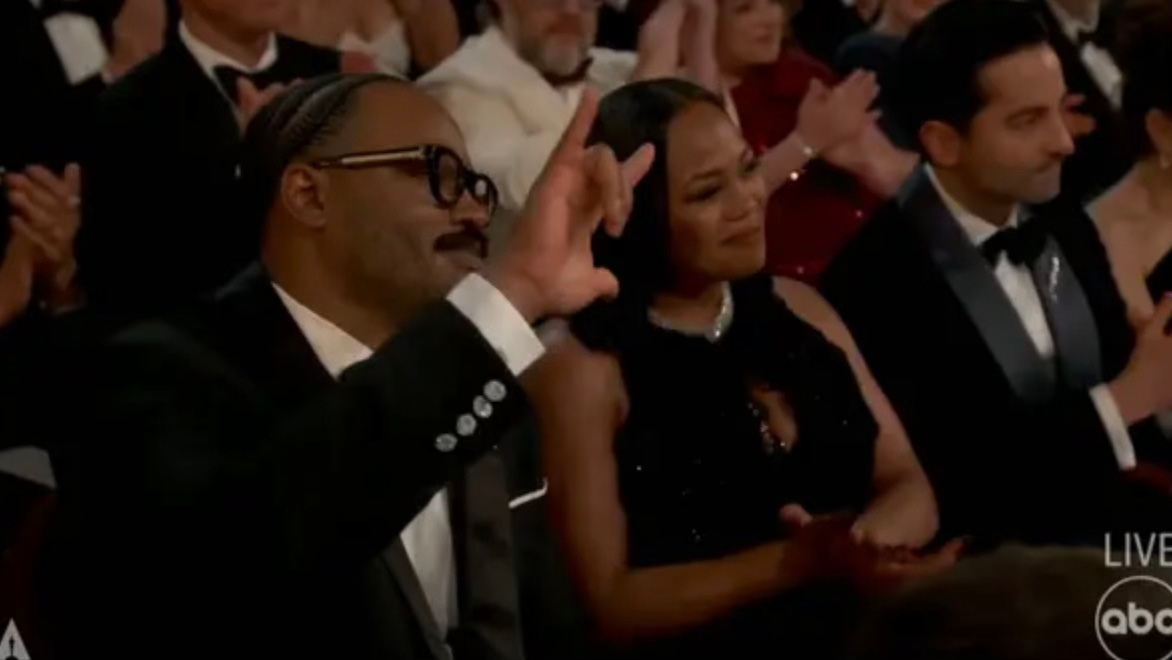
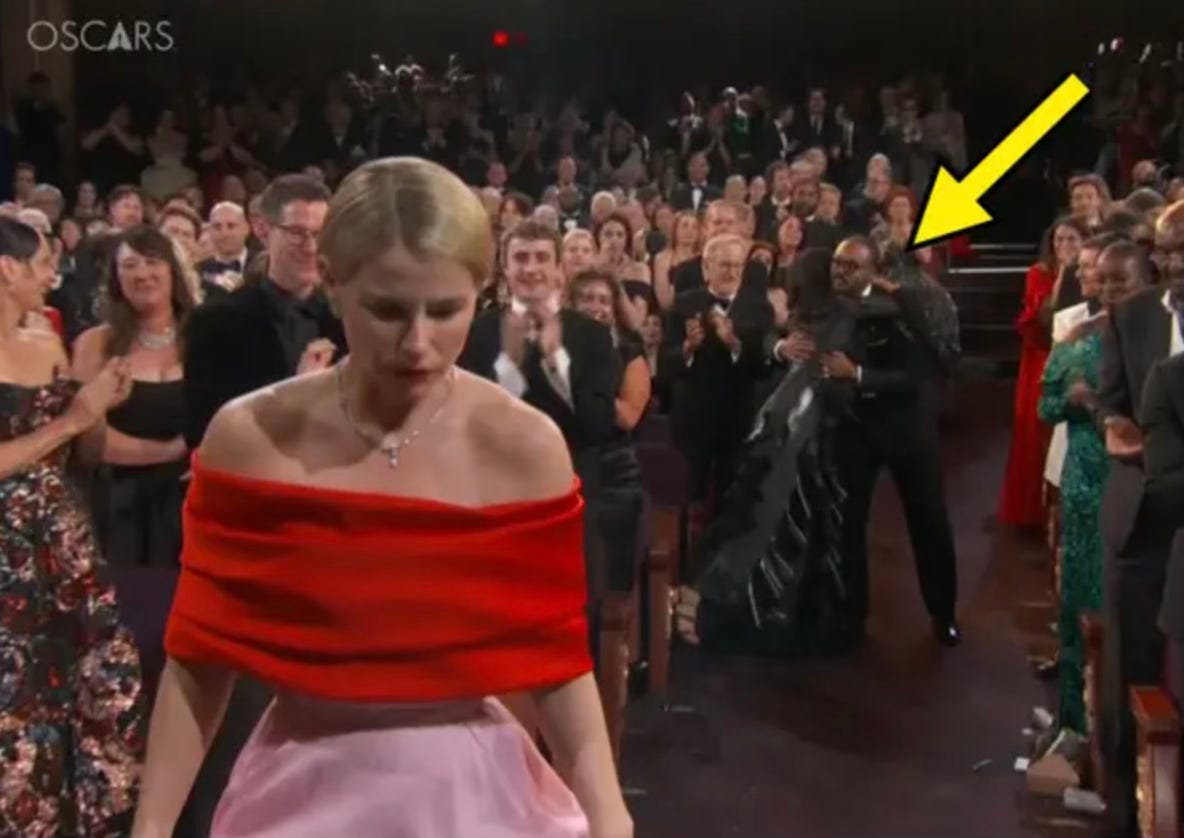
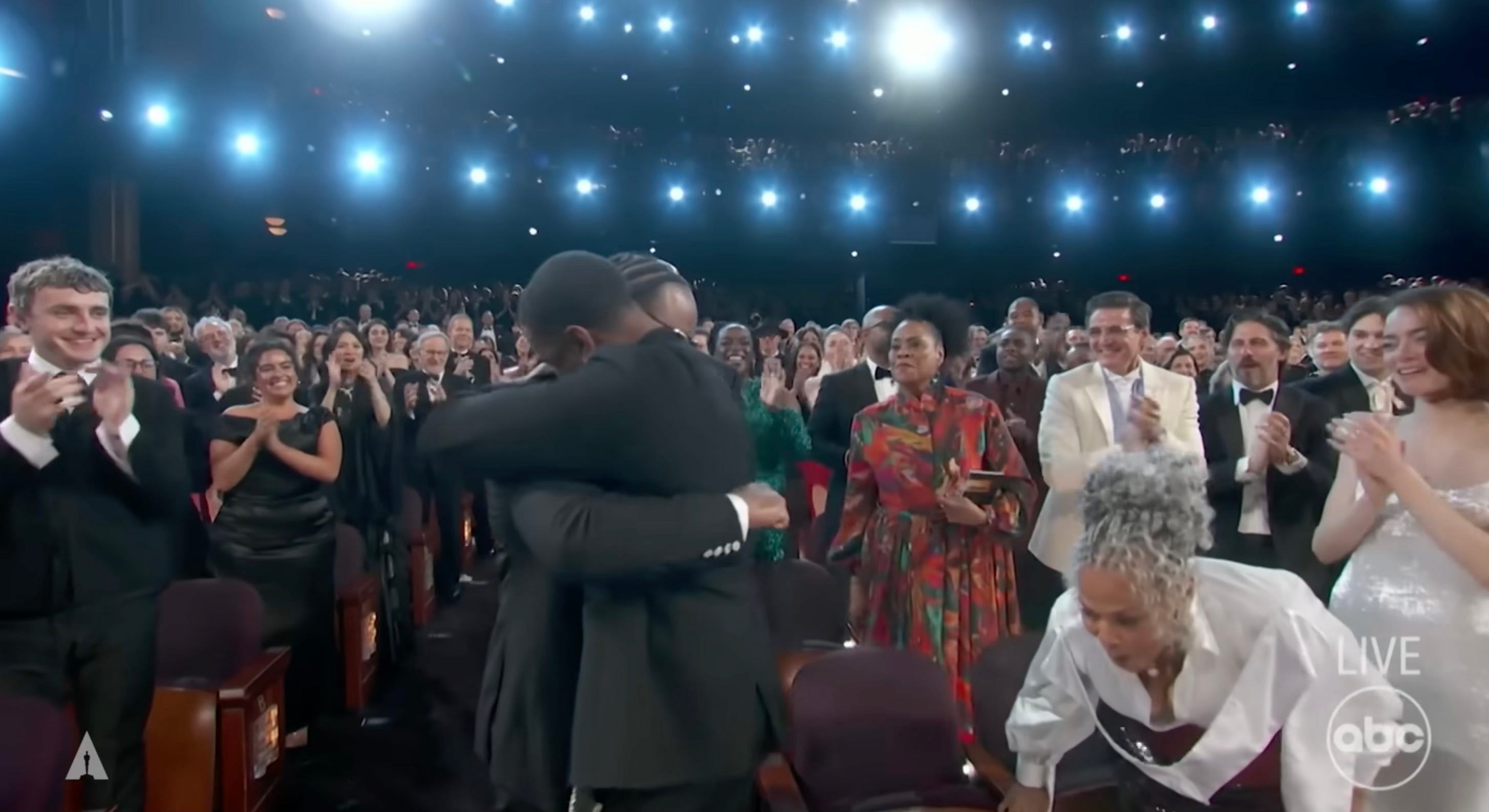
Yesterday, I made my kids (and my soon-to-be teenage son in particular) watch clips of Ryan Coogler signing “I love you” in ASL to his friends on stage. I made them watch clips of him hugging another man tenderly and then bounding back to his wife. I made them watch clips of him inviting his crew to stand up so he could praise them. I made them watch other people– Autumn Durald Arkapaw, Ludwig Göransson, Michael B Jordan– talk about how much he respects them, and what his trust has meant in their and their families’ lives.
I made them watch Arkapaw’s speech most of all. I wanted them to see it on its own terms, as a celebration of Arkapaw and her love and respect for her place in the history of women of color in film, but I also wanted them to notice Coogler’s role in her historic moment, as she became the first woman in Oscar’s history to be honored as a cinematographer.
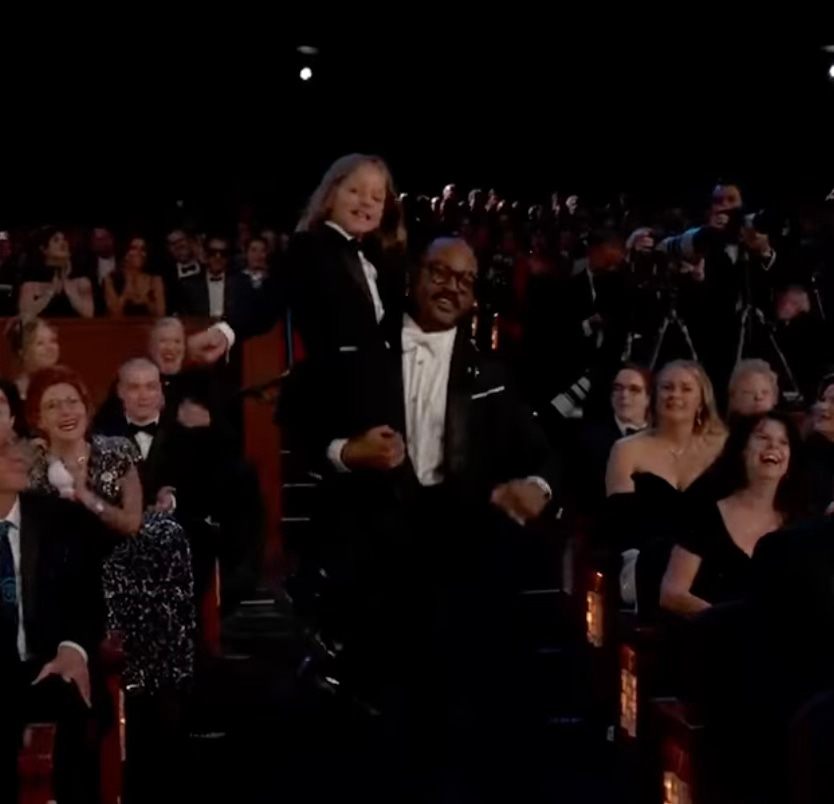
You likely saw it, or heard about it after the fact. There’s Arkapaw: taking the stage, vibrating, beaming. The first words out of her mouth, “Aidan, where are you at?” After a beat, the camera turns to reveal Coogler, sprinting down the aisle, carrying an ebullient Aidan in one arm. A mother and child reunion, with the mom’s boss in a supporting role.
It is gorgeous, on many levels. That Arkepaw’s instinct was to share this moment with Adian. That the ten year old was so clearly proud of his mom. And in the middle of it all, that both mother and son mattered so much to the famous man in the tuxedo, blood relation to neither, family to both.
Again, I don’t know Ryan Coogler personally, but here are some things I do know that seem germane.
When Coogler remembers what sparked his love for cinema, it’s sitting on his dad’s lap, watching Boyz n the Hood and other movies about Black fatherhood.
When Coogler talks about deciding to become a father, he evokes Oscar Grant, a Black man murdered by Oakland police and the subject of his first film, Fruitvale Station. Grant cried out to his murderers, “I have a daughter.” When Coogler and his wife, Zinzi made the leap into parenthood, he couldn’t stop thinking about Grant’s love for his then-four-year-old Tatitana.
In the video, you can tell Aidan is comfortable in Coogler’s arms, a sign that he already knows and was cared for by his mom’s boss.
Relatedly, both Coogler and Arkapaw have talked about how filmmaking takes you away from your family for too long. For Sinners, Coogler encouraged his cast and crew to bring their families down to Mississippi, to re-create a summer camp together.
Coogler’s 98-year-old grandma still lives just around the corner from where the Black Panthers held their first action. Her grandson visits regularly, delivering home baked sourdough bread.
Coogler signs I love you to his friends because Zinzi— not just his wife but also his professional partner and producer— is an ASL interpreter.
On the red carpet, Coogler talked about his sadness on Oscar night, because it would be the last planned opportunity for the Sinners cast and crew to all be together.
Coogler isn’t actually a member of the Academy of Motion Picture Arts and Sciences, which sponsors the Oscars, but is a proud member of the Directors and Writers Guilds. In his own words, “If I’m going to be a part of organizations, they’re going to be labor unions, where we’re figuring out how to take care of each other’s families.”
A man, in context. A man, aware that he is held up by a web. A man who actually loves women. A man who actually loves children, and not just his own. It need not be that complicated.
Because I am corny and too frequently tell rather than show, I blurted out a few too many of those facts to my kids yesterday. Probably just more paternal white noise, if I’m being honest.
I do worry about shoveling all this praise on another dude. Maybe I should just elevate women’s and trans people’s stories instead. Maybe I cheapened the power of Arkepaw’s moment by yelping, “LOOK AT WHO THAT IS, HOLDING HER SON!” I don’t want my kids to over-praise men for doing the bare minimum.
But I do want my son to be the kind of guy who adores other people, of all genders, who earns trust through care and interest, not through self-conscious declarations of allyship. I want my daughter to also love like that, and to know that she can and should expect care, tenderness and respect from men. And I want them to recognize the racial story here, to know that our country reserves a different narrative for them as white recipients and givers of love than it does for their Black friends.
I also hope they won’t let their own dad, the one who often tells rather than shows, off the hook.
We watched the clip of Coogler’s own acceptance speech last. Of course I teared up at the end, where he tell his own children how much he loves them (more eloquently and succinctly than I’ve ever mustered, I’d add) but I hope that’s not the lesson my kids take. Yes, I hope they know their dad loves them. But I hope they can name all sorts of kids their dad loves, and all sorts of places where children live and are worthy of love. I hope they tell stories of their lives, and others lives, in context. I hope they too feel cocooned in webs that stretch far outside the four walls of a house that, even when snowed-in, is never an island.
End notes:
As it turns out, it was a good Oscars for collective care and friendship. Of note; Teyana Taylor, one of the best celebrants of other people I’ve ever seen; Joachim Trier, who paraphrased Baldwin: “all adults are responsible for all children” (you will not be surprised to learn that Trier and Coogler are pals); and of course Javier Bardem’s “no to war and free Palestine.”
You all, I am SO CLOSE to announcing our first hosts for the Declaration of Interdependence Relay, but first: Alaskans, Hawaiians, Oregonians, Washingtonians (state), and Californians… your deadline to apply is tomorrow night! It does not take long to do so, I promise, and we will help you with your event (we’ll even give you a stipend).
One more thing I respect about Coogler: He believes that artists should strive to be useful to society, but that we also deserve to make a living doing so. I very much want to be able to keep supporting my family while doing this work, but I need your help to do so. Thanks for becoming a paid subscriber. The perks are really good, I promise.
Sharing with friends helps too. In fact, in a post-implosion of social media/atomization and oversaturation of the newsletter world, it’s the only thing that does. Thank you!
What the hell. Let’s look at more pictures of Ryan Coogler, a dad I really respect, hugging and celebrating his friends:
I love this!! Coogler and the whole cast were so amazing. Arkapaw’s speech was incredible ❤️ as was Michael B Jordan’s! I 100% agree with everything you say here- it’s absolutely what I was feeling while watching the Oscars. I was sad that Sinners didn’t take home all 16.
sigh, the cupboards, make me understand (this is a great piece and as a non-parent I'm doing that crazy thing where I'm sending it to the parents I love without fear!)