

I don't have any useful opinions about Lindy West's marriage, but oh buddy do I have thoughts on caring, however clumsily, for and about strangers
Standing off to the side of discourse, shouting "but parasociality is really interesting, if you think about it!"

When we talk about parasocial relationships, we scold. You, the consumer of art, are wrong for the intimacy you feel towards somebody you’ve never met. Or you are wrong for the way that you engage parasocially– too judgmentally, too sycophantically, too weird and creepy.
I mean, there’s something to critique here. We can be awful, both to loved ones and to strangers. A lady just shot up Rihanna’s house after ranting on Facebook about how the superstar was talking behind her back. Yikes.
Yes, and… we’re talking about a ubiquitous aspect of human life, supercharged by the trillion hub and spoke relationships of the influencer economy. Parasociality is not something that other people do. It is just how we live these days. Studies show that it can offer a stepping stone to less social isolation. But we rarely consider it with grace.
Let’s jettison the plural pronouns. I frequently judge other people’s parasociality. I yap about neighbor this and local community that. I caution against accepting simulacra of relationships. Try the real thing, I am always saying.
But what constitutes “the real thing?” While I am not a Super Famous Writer, I am fortunate to be connected, due to my work, to a growing web of people whom I love. People who support my family financially, and myself emotionally. People who tell me, gently, when I let them down. People who, in many cases, are now full fledged friends. Are those relationships parasocial? Or were they? Perhaps, but we only ever use that term pejoratively, so how can it represent the miracle of a stranger, thousands of miles away, welcoming my writing into their life?
And how should I act towards the voices in my headphones, or the writers whose books I’ve re-read a hundred times, or the director whose evening at the Oscars was fodder for my hamfisted paternal lessons? Is my distanced affection for them wrong? Some of it, I bet. But surely, it’s not just a miasma of flattened humanity and false intimacy. Encountering somebody else’s heart and responding with our own story…I mean, that’s not unlike a potluck.
Last week, my corner of the Internet was in an old fashioned tizzy. L’Affaire Lindy West. Perhaps you missed it. We live, after all, in atomized information environments (I can’t imagine an aide breathlessly reporting to the Pope, “your holiness, we’ve received reports that Aham emailed Scaachi Koul an expletive-filled rant in response to her Slate profile– it’s a real mess”). If this is new to you, you are neither a better nor a worse person than those deeply immersed in it. That’s just how algorithms work.
The point isn’t the story itself. It never is. But also, I wouldn’t be thinking about parasociality right now if I hadn’t read too many presumptions of discontent in the House of West, so here I am, discoursing like a hurricane.
Unlike myself, Lindy West is a Super Famous Writer. She helped create the 2010s feminist Internet– funny, intimate, interested in the personal-as-political, simultaneously unapologetic and self-deprecating. Because she is a woman (and because she’s a fat woman who writes about her body), she has long been on the receiving end of degrading threats from men. That’s on top of well-meaning but patronizing advice from strangers projecting their lives onto hers, and the generalized exhaustion that comes from being publicly perceived. No wonder she and I (much less prominent, and also a guy) have a different relationship to writing in public. Of course I soliloquize about the gift of strangers’ attention. Must be nice, West would say, if she knew me.
Lindy West just released a memoir. It’s about many things (it’s very much about the weight of being somebody whose partially told story of self matters so much to strangers), but its most salacious concern is her relationship– previously with one person, now with two.
There is, my God, so much here: polyamory, and what does or doesn’t make it ethical; interracial relationships; cross-gender marriages where the woman is more famous/successful; fatphobia; dudes in relationships who lie, cheat and act like jerks; whether that dynamic is changed by the fact that the dude-presenting (and behaving) partner in question has, since the book’s publication, come out as nonbinary; white guilt, as both a productive and manipulatable force; all of our collective feelings about 2010s Internet leftism; the metropolitan Pacific Northwest and, you know, its whole deal; whether memoirists are reliable narrators and if that’s any of our business; and most of all, if it is more feminist to trust or doubt the famous woman when she assures us that her partner, who she admits was an “asshole,” makes her happy now, she swears.
I am sure that I am missing some layers, but I plan to weigh in on none of them. So many others have, including West and her partners (“Um, Mr. Pope, sorry to bother you again, but Roya’s email to Scacchi Koul was also pretty mean”). It is all quite messy and overly familiar and centered on topics with which I have zero expertise (if you would like to hear a mini podcast episode about how little I know about polyamory, you are in luck).
The original title of this piece was something to the effect of, “there is more to politics than having perfect opinions about other people’s lives.” I stand by that , but you can imagine the variety of essay that would have followed. I was gonna pox all over all y’alls houses. Towards people defending or excoriating West: why not do something beautiful in your own neighborhood instead? Towards West, and writers of her milieu: understand that we helped create this ecosystem. We built careers on telling people that their identification with us, and our worldviews, was itself a form of doing something useful.
Particularly for writers such as West, whose fame hinges both on their moral valence and relatability, why is it surprising to learn that you play a disproportionally load-bearing role in other people’s political and relational lives? Just a few years ago, West’s fans were invited to celebrate her marriage as a political act of body liberation. It is a hard sell, to then admonish those same fans for continuing to read that marriage-made-public through a personal and political lens.
I considered all that and then got sad, an ill-suited emotion for excoriation. I can neither blame West for making her living as a confessional memoirist, nor her readers for responding in kind. Much more than West’s love triangle, that’s the potential codependent relationship— rife with feelings of betrayal and heartbreak on both sides— that fascinates me the most.
They tried, West and her fans. And perhaps the famous writer shouldn’t have been the vessel for so much diasporic trying, but in a nation of lonely islands, that was the one made accessible.
I mean, we’re all just trying. I imagine that everybody writing think pieces about America’s most over-analyzed marriage knows that the part of our self that cares for strangers would be put to better use volunteering for a mutual aid effort, or protesting the war in Iran. Nobody needs another lecture from me to that effect.
I trust that we would all prefer to connect in real ways, with the people in our immediate vicinity, but so often that feels impossible, for reasons both imagined and real as hell. And yet, we want to reach out our tendrils of care to other human beings, so of course when a writer whom many people have followed for two decades bares their soul, it produces soul-baring in response.
This, for me, was the early 2010s left-liberal Internet: an overstuffed mess of overly strident first person essays and performative dogmatism for which I have a great deal of affection. The problem was never that we gravitated to strangers’ stories, nor even that we preened and performed for one another. We were making sense, out loud, of a sub-optimal world. Of course the statement superseded the action. That’s often how it goes when you’re practicing.
Whenever there is a critique of parasocial behavior, the author usually makes a token reference to the original article that coined the term, by Donald Horton and Richard Wohl. I’ve seen it cited hundreds of times, but never read it. It’s written in the 1950s, about the then-medium of television. It’s far more generous than I imagined.
“Sometimes the ‘actor’- whether he is playing himself or performing in a fictional role– is seen engaged with others; but often he faces the spectator, uses the mode of direct address, talks as if he were conversing personally and privately.”
Well no wonder our television-watching forbears responded to moves like that parasocially. Those are connective poses, be they earnest or manufactured. How can we help but want to reach out, in response, through our screens?
West earned her audience because she’s immensely talented at inviting other people into her life, but that doesn’t mean that her life should dissolve in a flood of strangers’ vicarious opinions. I imagine this is a hell of a moment for her, and I’m legitimately sorry for all the mean-spirited, bad faith ancillary takes she’s had to weather.
But I also understand why West’s fans are processing so many emotions out loud. It’s not just wanton gossip. She skillfully connected her life with that of thousands of others, and when tethers like that fray, broken hearts on on both sides will grieve, rage, or just a need to state their worldview out loud again, to grasp onto a center worth holding.
This should never be our end point, a cyclical argument about a stranger’s marriage. Telling the famous lady to get divorced will not bring a grand victory for feminism. Neither will critiquing others for doing so, shouting “how dare you deny the famous woman her agency.” But I get it. We’re all trying to care, and to have our care add up to something. And this is the imperfect space we’ve been disproportionally given to do so– logging on, experiencing somebody’s story vicariously, expressing an opinion.
There is, indeed, more to a political life than this. But it’s not our fault that we find ourselves here. We are figuring out new answers, thank goodness. We’re bumbling, but we’re bumbling towards each other. I may bemoan our continued distance, but I trust we’re getting closer. How can we not, when being apart is so unsettling?
End notes:
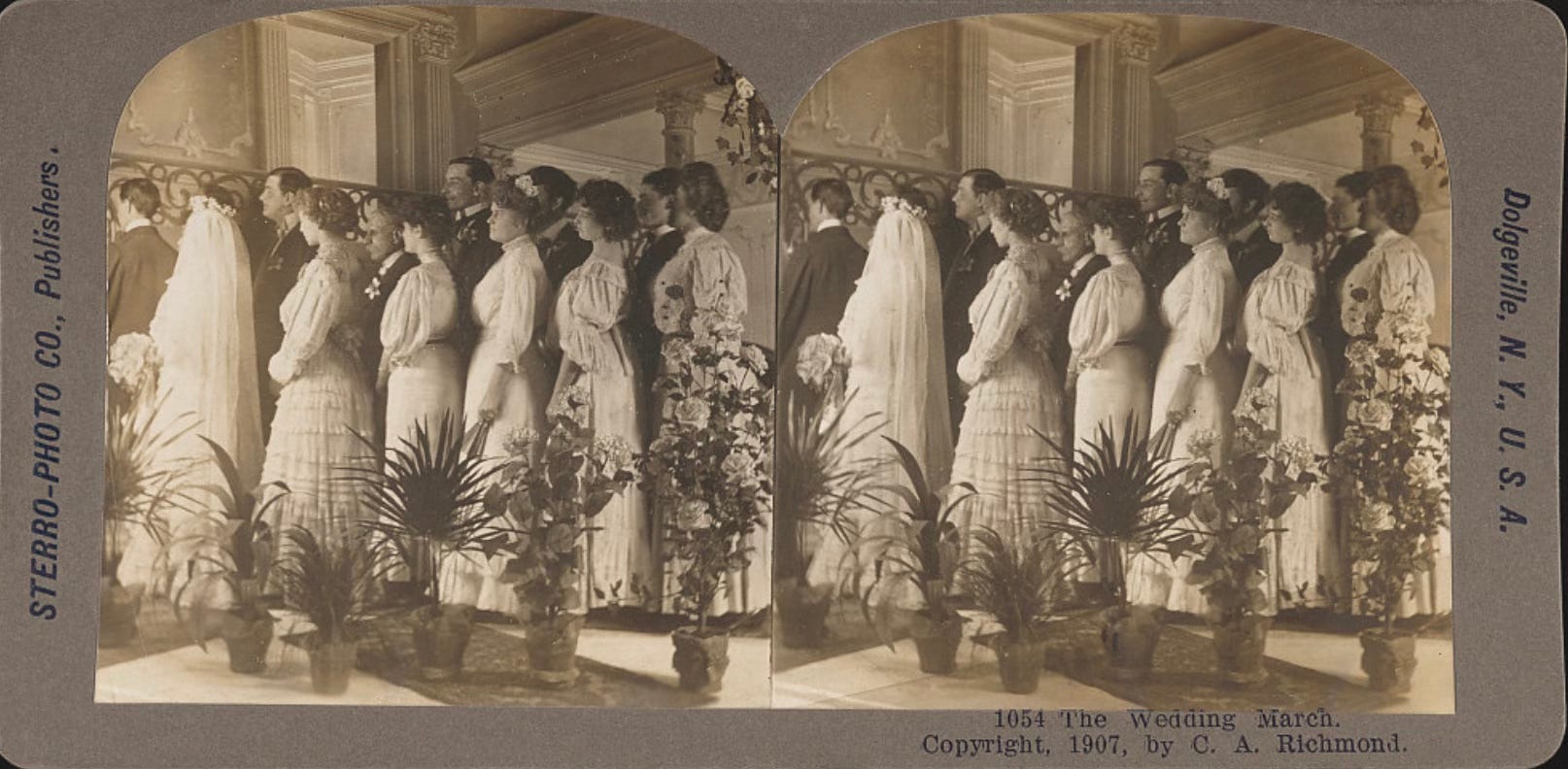
In searching for pictures for this piece, I went, as I always do, to the Library of Congress’ archive. They have a lot of wedding themed pictures in there, but you are welcome that I did not choose this creepy one of three cats getting married (?). You’re welcome, parasocially.
This time next week: We’ll be announcing our first hosts for the Declaration of Interdependence Relay. Oh my God I’ms o excited. In the meantime, if you live in Idaho, Nevada, Utah, New Mexico, Arizona, Colorado or Alaska… now would be a very cool time to apply! It does not take long to do so, I promise, and we will help you with your event (we’ll even give you a stipend). How’s that, for potential connection.
I hinted at this before, but I will never take it for granted that a number of you, most of you strangers, value me and this work enough to support it financially. My whole family is very grateful for you. I would love for more of you to become paid subscribers, and I’ll be grateful for you as well. Also, the perks are really good, I promise.
Sharing with friends helps too. In fact, in a post-implosion of social media/atomization and oversaturation of the newsletter world, it’s the only thing that does. Thank you!
Don’t forget to vote in our March Madness Potluck Throwdown. The “things that are called salads but contain little to no vegetables” region could literally go in four different directions (I am so proud of you all that egg salad doesn’t have a chance).
As a writer and a memoirist (albeit not a famous one by any stretch of the imagination), I thoroughly enjoyed your ruminations on all of this. I do think that there is something inside of us that wants to connect with people who share some beliefs or characteristics with us (I am a white feminist who used to live in the same Pacific NW town as Lindy and saw her speak in person a few times and it was thrilling to think that we had things in common). And, sadly, I think that in our minds, we begin to create stories about all of the things that extrapolate from those thin connections - "well, Lindy would certainly feel the same way I do about X" - because we want (need? desperately crave?) that sense of belonging via confirmation bias. So when we discover that there is something fundamentally different about the way they think or live their life, those of us who haven't spent a lot of time practicing unconditional positive regard begin to feel betrayed or misled. It is a strange phenomenon that we either get angry or feel as though there is something "wrong" with that person that we now need to offer them advice to fix ("get divorced, Lindy!") rather than slowing down to realize that it is possible for us to witness someone else's story and identify deeply with parts of it while having other parts of it feel alien or frightening or downright "wrong," and still have affection for them and see them as worthy of our admiration. That was a lot of words, but clearly, you can see how this post struck a chord with me. ;-)
No one who experiences me para-socially here will be surprised to find that I have THOUGHTS about Lindy West's marriage and memoir, even though I haven't read the latter and even though I have officially eschewed the institution of the former. But I have been married, and that marriage was plagued with trouble related to polyamory (and my ex being an asshole). And I have been in successful poly relationships subsequently. So, yeah, I have THOUGHTS.
But I also had thoughts about Hilary Clinton's marriage (Still do. Fuck that guy.), long before the internet really existed for most of us. I think anytime any woman puts her marriage into the public discourse, or holds it up as goals in any way, women, especially, take that relationship personally. Is it right for us to do that? Probably not. But because women are so defined by our relationships, particularly the status of our romantic relationships, and we are also treated as a monolith (like all oppressed groups) we are downstream of any and all public perceptions of any woman. It's not fair, but it's true.
Lindy gets to make her own choices, whatever I may think about them. But the perception of her choices does potentially effect my life as a single woman contemplating whether or not to pursue romantic relationships and what structure might work. I wish that weren't the case. I wish I felt better about her choices. I wish I didn't want to reach through the screen and bitch slap her husband. But here we are.
For whatever it's worth, this is the sum total of what I will ever say about Lindy West's marriage, anywhere, ever again. "If you can't say something nice" feels appropriate.