

I want to tell you about a book that I loved so much that it's changed how I read other books
And also another book that I adored immensely, and the dialogue that's been playing out between them in my mind

The best thing about being joyfully overwhelmed by a book is that you get to keep experiencing the gift of it over and over. The worst is that, in most cases, you are the only person you know walking around with that New Epistemology Glow. Your friends didn’t read that book, or they did, but it didn’t click in quite the same way. Sometimes, you live your truth in quiet, keeping your bound fount of wisdom to yourself. Or sometimes you make this new book your personality, you wave your arms around and shout things like, “Ok I’m probably not describing it well; let me try that again…”
What I’m saying is that I want to tell you about a book. And then I want to tell you another book, also remarkable, which I would have loved no matter what, but that I appreciate even more given the first book.
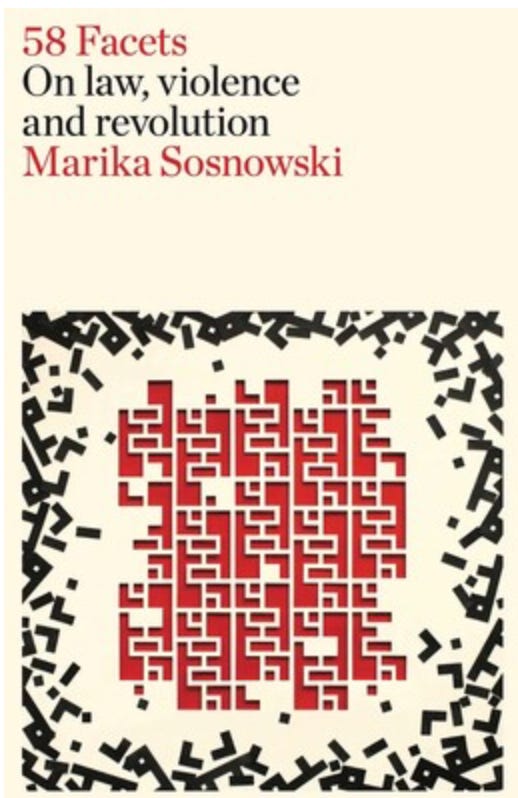
Oh, and I should probably be honest that the book in question, 58 Facets: On law, violence and revolution, by Marika Sosnowski, was published in Australia, and as of this writing may or may not be easy to buy a physical copy in North America (though you should very much try to do so, and if you hit a snag, grab an electronic version).
So why am I doing my arm-waving-maniac act about a book that you may or may not be able to purchase, one that (by design) is a bit of an unclassifiable oddity: part memoir, part sociology, part work of legal scholarship, part expose? Because of passages like this (the 41st of the titular 58 facets).
“We constantly move toward [liberation], we work every day for it through large and small acts of revolution, through small cracks in precedent, through forms of care, of tenderness, of violence, of ingenuity, of resourcefulness, through joy and survival. And sometimes nothing happens for years. And then years—decades even—happen in a few days.”
58 Facets is about a number of things that human beings do to and with each other, from the hope-giving to the horrific. It is globe trotting and time traveling, jumping between Europe and the Middle East and Australia. There are, contained in its pages, Holocausts and Nakbas, dictators and functionaries, violence administered by bombs and statutes, trauma experienced both directly and, generations down the line, as a phantom limb.
Throughout, Sosnowski returns to the framework of checkpoints and camps, imaginary but strictly codified geographies where human worthiness is determined by law. These inventions are everywhere, Sosnowski asserts, not all of them immediately death bringing, but all married by the intertwining of violence and law. They are stories we have always told ourselves: “It is necessary to keep you on this side of a line, or constrained in this space, not because we are cruel because that is the natural order of things.”
To read 58 Facets is to be confronted with the ways in which the prefix “in” feels impossibly wed to the suffix “humanity.” We are so awful to each other that we find ways to reify our cruelty. Who can argue with checkpoints and camps, if we are told the alternative is chaos and disorder?
And yet, that is not the entirety of our being. That 41st facet creeps up on you, just as revolutionary sparks often emerge when least expected. We are always resisting, us humans, because even if revolution is not a magical switch that, once flicked, will deliver liberation tomorrow, there is something in us that is drawn towards… call it freedom or love or a right ordering of human relationships. We keep trying, even if we don’t know where the trying will get us.
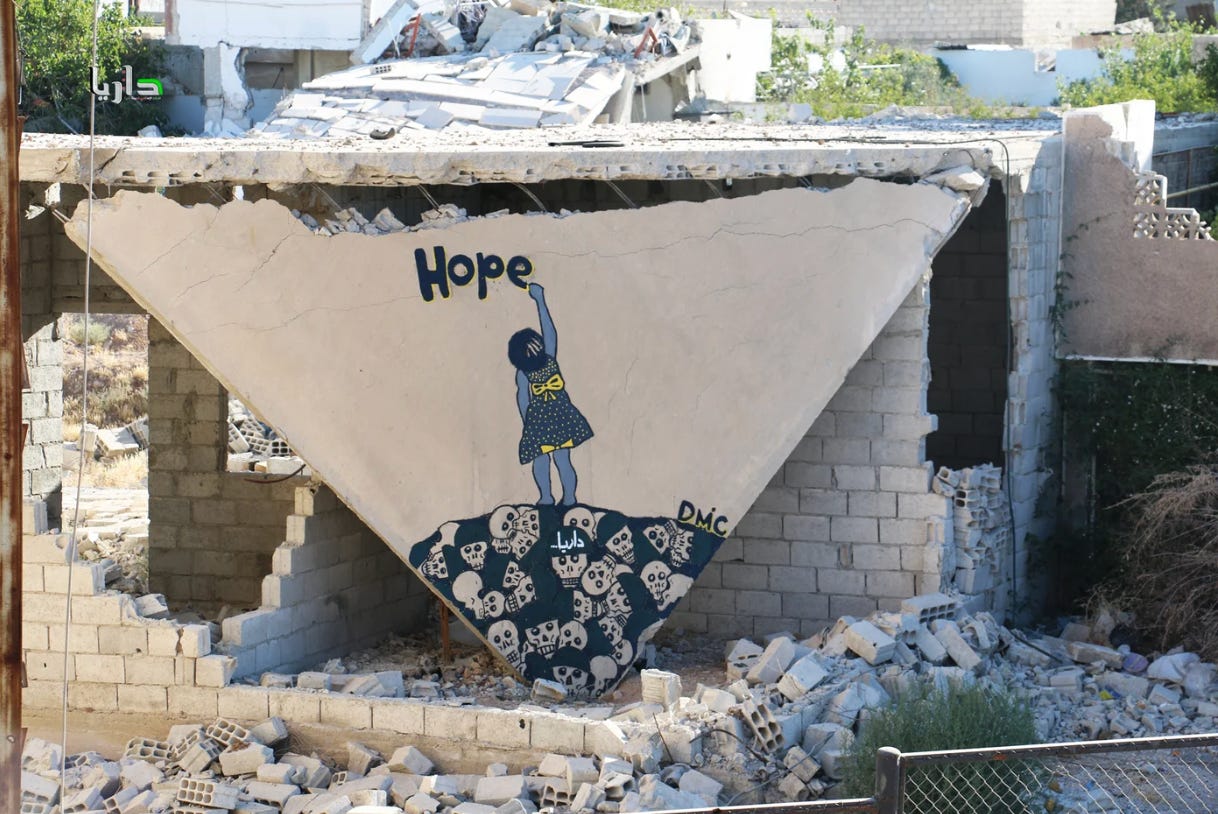
The language of facets comes from diamonds, gems meant to be held into the light in any number of ways. A facet never reveals a single truth. It depends on the angle at which you view it. When Sosnowski introduces readers to the city of Daraya, Syria, where an unorthodox local sheikh named Abdul Akram al-Saqqa inspired followers living under the backdrop of state terror to build a home for a variety of dreams—community care, gender equality, democracy— it’s natural to wonder will this story be tragic or triumphant, will my heart be uplifted or destroyed?
58 Facets has too much love and respect for the people of Daraya, and for you as a reader, to fall into the trap of a binary answer. Instead, you are left with a very different variety of question. What does it mean, to live a life and posses a heart, if that heart will inevitably be split into a million pieces but will also keep beating?
Or, I should say, that’s the question with which I was left, perhaps intentionally, or perhaps because that’s the angle at which I held this book to the light.
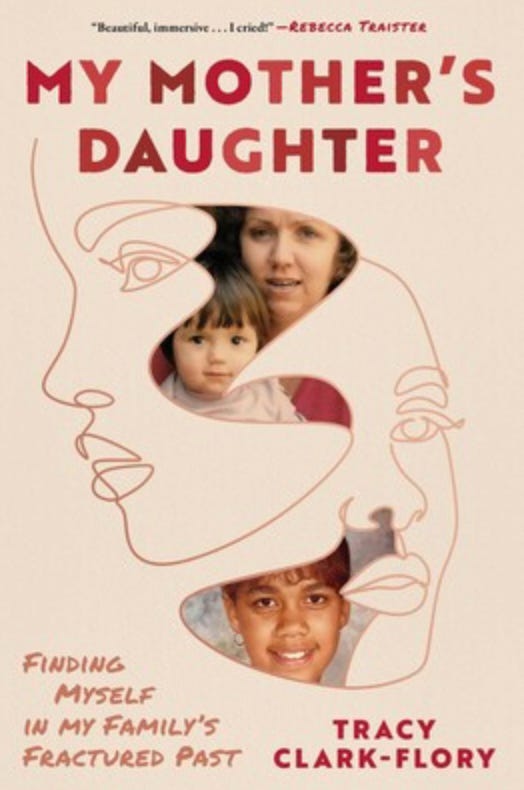
I finished 58 Facets a couple months ago, but it’s been with me every day sense, including when I finished an ostensibly quite different book, Tracy Clark-Flory’s familial memoir My Mother’s Daughter. My brain couldn’t stop from putting the two in dialogue with each other. There they were again, the camps and checkpoints, the hungry ghosts of shame and longing that pop up generations in the future. But also, that pesky humanity inside us. The draw we have, towards reunion and reparations.
There are camps in Clark-Flory’s book, in particular a long-shuttered home for unwed mothers on the West Side of Chicago. Clark-Flory’s own mom was forced into that home when she became pregnant in college— one of many young women disappeared because their sexuality was a problem to be solved. There are also checkpoints, like the liminal space of the American adoption system through which Clark-Flory’s older sister Kathy traveled after being taken away from their mom.
Clark-Flory, like Sosnowski, is a masterful weaver of the systemic and intimate. Like all family stories, hers is one marred by the worst constructions of human cruelty—patriarchy and racism and American capitalism. There are monsters in Clark-Flory’s narrative, human beings who’ve convinced themselves of the inevitability of camps and checkpoints and the need for some people to be punished to cleanse and anoint a chosen few.
But hers is also a love story, a Velveteen Rabbit tale of mothers and sisters and fathers and aunties and nephews who can’t help but run towards each other, hands outstretched. It is about mourning and raging and then, after turning your insides out a million times over, looking out into the world and discovering that you aren’t alone.
So here I am again, arms waving wildly, desperate to reduce the complicated truths of either book to a trite blurb. We are inheritors and perpetrators of great cruelty; but our love for each other contains the seeds of a million revolutions.
I mean, that’s not an inaccurate summation of my feelings. And friends, if you know me well, you know that I am not above tying my thoughts up in a saccharine bow. But, in the spirit of how much I’ve been pulled into the complex and (ahem) multi-faceted world of both books, I will resist that pull. What if instead I sat with that summative statement, if I treated it less as a declaration and more as a discipline.
What if I turned that sentence over in my head over and again, sometimes as a riddle, sometimes as a taunt, sometimes as a prayer. What if, on some readings, the first clause overwhelmed me so thoroughly that I never got around to seriously considering the second half. What if, at other times, I repeated the latter clause over and over again, until it filled me up. What if some days I was numb, and none of these words meant all that much to me at all.
And what if, one day, I heard the same sentiment, in somebody else’s words. What if I yelled across the room, “YES!’ and they yelled ‘YES!” back and then we found our way towards one another.
End notes
I should probably disclose that I am lucky enough to know and admire both authors, though that doesn’t explain either why I felt compelled to write about them. I am fortunate to read many great books by people I know and admire personally. It’s far rarer, though, to read books that I not only love but which I can’t get out of my mind. Neither author goaded me to write about their books in any way, let along with awe and gratitude. I came by that naturally. Also, that’s a pretty nice reason to have a newsletter, so thanks for allowing this to be a space where that awestruck feeling can live out loud.
There are links to purchase both books above, but to put a finer point on it: I highly recommend buying and reading both My Mother’s Daughter and 58 Facets, the latter of which is worth any extra clicking you have to do to find an electronic or print copy in your part of the world (the former is a new North American release and should be easy to buy just about anywhere).
In case you’re wondering whether it continues to be an immense joy to facilitate a 50 state relay of community gatherings… the answer is VERY MUCH SO. I just got back from a whirlwind trip to San Francisco and Kauai (where I saw some of you! and also where I got quite tired but also where my heart grew quite full).. Those reports coming soon, but in the meantime you should read about the Portland and Seattle events.
A quick reminder that applications for the North Dakota, South Dakota, Montana, Wyoming, Nebraska and Kansas gatherings will close on May 31st. Did you know we give you a stipend to host a gathering? And that it doesn’t have to be a super complicated production? You should probably click this link to learn more, don’t you think?
We HAVE chosen our NV, AZ, CO, NM, UT and ID hosts. They’re not all up on our website yet (we’re confirming a couple dates), but keep checking back through the week. A heads up that. I will not be at most of these myself, but the point of the relay is not my own travel dreams— it’s building a web of inspiring gatherers.
You know what makes me very grateful? The fact that I am able to do this for a living, both writing and hosting community gatherings and hopefully making the work of processing this world and building a better one a bit more bearable for you. This sounds trite, but it’s very true: the only reason I’m able to do so is that, at the end of every email I make a pitch to you all to become a paid subscriber and… a few of you do (usually enough to make up for folks who supported previously but whose finances no longer allow them to do so). Please consider! Thank you!
This two-part mantra you've come up with is so so beautiful. Reminds of a line from Manifesto: The Mad Farmer Liberation Front by Wendell Berry that I think about a lot: "Be joyful/though you have considered all the facts."
The ebook of 58 Facets is available on Indiebound for anyone who is interested in reading it that way. Looking forward to checking it out, Garrett. Thanks for the recommendation!