

You will never win at AI
On rigged games and loser industries

You’ll remember, a few months ago, when college graduates across the country booed the living daylights out of AI-boosting commencement speakers. It felt great, or at least it did to me, being that I am both anti-AI and instinctually aware that there is nothing more terrifying than being jeered by a crowd 16-25 year olds. I mean, just look at this quote about Google CEO Eric Schmidt from a recent University of Arizona graduate.
Absolutely brutal stuff. “Just like, Ok? Why?” If I were Google CEO Eric Schmidt I would’ve immediately evaporated into thin air. I generally lean more towards persuasion than public shaming. But still, if I had a billion dollars to fund a social change movement, I’d be tempted to hire thousands of judgmental twenty somethings to travel en masse to every professional writer’s house. At the moment that writer opened up a generative AI tool to “supplement their authorial voice” or whatever, my crowd of gum popping mercenaries would roll their eyes and issue the most powerful retort in the English language.
“Ew, gross.”
On many metrics, the “ew, grosses” are having a moment. AI is now less popular than ICE. Two thirds of us think adoption is moving too fast. Opposition to data centers is the only issue bringing us together across party lines. What’s that in the air? Backlash, baby. Or, as anthropologist Jasmine Sun puts it, the rise of “AI populism… a worldview in which AI is viewed not as a normal technology, but as an elite political project to be resisted.”
Hell yeah to that. Love when an elite political project is resisted. But here’s the rub. Sure, we’re all mad at Sam Altman, but we’re also mad at Jeff Bezos, and we’re still one-clicking him all the way to the bank. Over half of American adults report voluntarily using AI tools, and 40% say that they increased their use in 2025. That’s pretty hefty adoption levels for technology that makes everybody’s writing sound like a LinkedIn post.
You heard this a lot, during this spring’s boo-a-palooza. “Those kids are hypocrites, because they’re the same students who use AI to get out of doing their classwork.” That’s the kind of statement that’s hard to prove empirically, but it rings true. A lot of college students use generative AI, and a lot of graduates booed. Surely, there’s a hefty Venn diagram there. I mean, people even use AI to make anti-data center flyers. The line between anti-corporate crusader and dutiful consumer isn’t as cut as dry as we like to pretend.
The lazy way to square that circle is to just chalk it all up to hypocrisy. Everybody loves to be righteous in a crowd, but we’re all looking for shortcuts when nobody’s looking. But there’s another line from an AI-skeptical member of the class of 2026 that I haven’t been able to forget.
“I think at the beginning we were excited about it and it was this cool thing, ‘Oh, I can write an essay for you,’ but now like, we don't want that anymore and we don’t want it messing with our job prospects and messing with the jobs that we’ve worked for years— so hard for for years— to kind of eligible for.”
That’s from Kareen Gill, who just graduated from American University. And she’s hitting on something both honest and profound. This isn’t hypocrisy or virtue signaling. It’s a political awakening. A group of people was sold a false bill of goods, but then the dissonance became impossible to ignore. That’s literally how political movements start, as long as they’re properly nurtured and new arrivals aren’t scolded for having once taken the bait.
Even as a consistent AI skeptic, I absolutely understand why so many others bought the initial sales pitch. Every time I’ve ever been told that I have to use AI, the argument’s always been the same. It was about being left behind, and how there was presumably no worse fate. “Why would you turn your nose up at a revolutionary new tool? I mean, you’re using a smart phone instead of a typewriter, this is just like that?”
I don’t know, man. These days, I could totally go for a typewriter and a rotary dial phone versus an addiction machine in my pocket, but still. I remember when I didn’t feel that way, when I too was worried about being the last on board with this or that new tech breakthrough. I remember the first time a friend told me about this new thing called Facebook. I booked it as fast as I could to the nearest desktop.
I should also acknowledge here. It’s easy for me to avoid proactively using AI. I don’t have the same institutional pressure that’s been piled on so many of my neighbors. I’m not at a workplace that mandates use of enterprise AI software. I’m not an educator whose district has bought into some fly-by-night ed tech contract. And I’m not one of the many college students whose universities, particularly cowardly in the face of “left behind” rhetoric, essentially assigned Chat GPT or Claude as an institutional study buddy.
Back to the college students. Many of them, no doubt, thought that AI could be a cool tool that would allow them to hack the system. “That professor wants me to waste the best years of my youth writing a term paper? Jokes on them. They don’t know how much I rule at prompting.” But there’s nothing like graduating into a decimated job market and having your resume auto-rejected by robot after robot for the truth to reveal itself. They, the individual AI user, were never in the driver’s seat. The technology they were using was a tool, but not for them. It was always a means to an end—one more way to transfer wealth and power to those already on top of the societal pile. AI looks like your friend, but it’s the kind of friend that schemes behind your back, steals your money, and might also murder you.
There are plenty of ways to make essentially this same point. The nascent scribe who turns to Chat GPT and never actually learns to write. The lonely chatbot user who learns to trust sycophantic lines of code more than other human beings. The kid who thought they found a lifeline in a large language model, until the robot told them to kill themselves.
You can’t win at any consumer-marketed AI, because AI is incapable of mutualism. It’s an insatiable consumption machine. Everything placed in its path is gobbled up and spit out. Books and art and intellectual property. An entire town’s power and water supply. Your attention. And for what? So that the machine itself can grow larger and smarter, so that next year somebody can say “See? AI got better! Everybody loves robot writing more than your drivel; it’s so embarrassing that you ever believed in yourself.”
Why is AI desperate for consumers, even who truly believe that they’re using it responsibly? Because all the prompts get spit right back into the system in the name of “improvement.” We’re at a stage of capitalism where we’re always the product, but this is a business model whose core value proposition is to tell us that we suck and are nothing without it.
When I’ve made previous entreaties against generative AI use, especially in writing, I’ve gone flowery and plaintive. I’ve talked about trust and the social contract of authorship. Earnest, sure, but it suffers the same fatal flaw of most of my entreaties. We all know what we should be doing, but that’s the whole game of commodity fetishism and plausible diability. “Yeah, yeah, yeah, it’s all bad, but my contribution is just a drop in the bucket….”
That’s why I love the booing. It reaffirms the distance between us and this technology. It punctures the myth of inevitability and reminds us that we had a life before the chatbots. Perhaps you’ve used generative AI. We get it. But you can stop at any time.
For a few years now, we have been inundated with messages that using AI is nothing more than a cool life hack. Celebrity Super Bowl commercials took the Goofus and Gallant approach, pitting a savvy AI user against their stuck in the mud luddite buddy. In a sense, the AI industry pitched itself less as righteous than subversive, a window to a future where the haves were renegades and the have nots were a bunch of whiny babies.
But now, the bloom is coming off the rose, which means that it’s time to take out the hedge clippers and finish the job. The original luddites were radical activists, and they were also right. We should say it loudly and proudly and at every possibly opportunity: Generative AI is loser technology and it doesn’t deserve you. The more you use it the more we all lose. Maybe not immediately, but eventually. You will give more of your data, trust, money, water and critical thinking skills to the consumption robots, and what you’ll get in return won’t ever belong to you. It won’t be imbued with your animus or soul. It will be a reasonable simulacra of the kind of thing a human being would make, just, you know, lacking all semblances of humanity.
I don’t need you to argue with me about why you should be allowed to use AI. I’ll just reply with honesty and love: you’re great, but AI is a loser machine. And I hope you don’t use it, not because you need to prove your morality to me, but because I don’t want you to lose. I think you deserve better than a resource-guzzling, death-causing, random word generator.
The consumption machine doesn’t believe in you, and that’s why it wants to trick you, extract as much data and information as it can from you, and then move on. If its intelligence is artificial, so too is its heart. It tells you that you need it, that it’ll make your life better. And maybe it will, up until the very moment that it won’t.
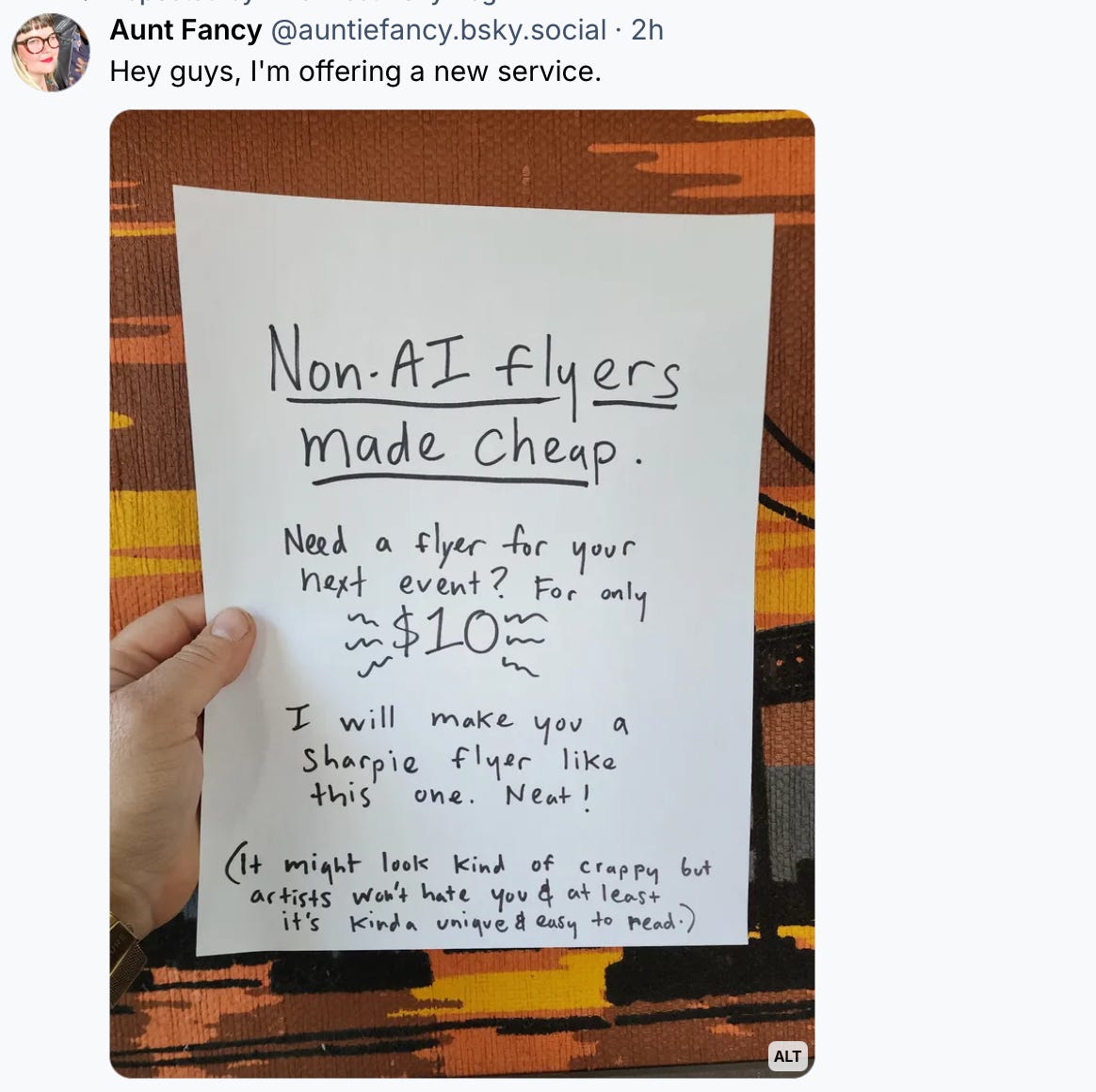
The AI flyer might look better, on a technical level, than the one you could make yourself. Art is hard. Your essay would emerge much more quickly if you used AI at any stage in the writing process. Writing is hard. You may get a more effusive response from a chatbot than a friend. Relationships are hard.
I’m not pretending that there’s nothing consumer-facing AI can do for you. But we’re not so far down the line that we can’t choose each other instead. Not all of us are going to be the best writers, or researchers, or spreadsheet tabulators, or flyer makers. Which means, just maybe, that we have to turn to each other for help. Or better yet, that we can get better at offering to lift each other’s loads.
You’ve heard something to this effect before, and it sounds cliche, but it’s still true. The point of any pursuit is the trying. The point of being alive is living. The point of humanity is other humans. Would you give that all up, for a machine that just wants to take from you? Really?
Or to put it more succinctly.
“… just like, Ok, why?’
End notes:
This essay, like all my essays, was researched, outlined and written by me, a human being, without the aid of any AI technology. And I loved writing it, but doing so took multiple days of research and drafting, on top of a nearly full time job running events across the country (for which I’m not currently receiving a salary— we have a grant, but it’s currently funding my professional partner’s time, not my own). I’d love to keep doing this— writing, organizing, and assuring you that, for better or worse, this is all me—but I also like being able to help support my family. If you enjoyed it and can pitch in, great! I’ll work hard to make it worth your while. If not, I understand and am still grateful that you’re here.
This essay might also explain why I’m currently hosting 50 gatherings in 50 states, since the only antidote for a world where we’re told not to trust ourselves and our neighbors is to turn to the people closest to us and build with them. A few updates:
Here’s an Instagram post that succinctly explains our progress and also makes a pitch to apply if you’re in our next region of states (IA, MO, KS, OK, AR, LA and TX). It’s fun (both the post, but more so the experience of hosting— if you live near one of those states, I hope you apply by June 30th).
We’ve literally got an event TONIGHT— a community discussion in the Las Vegas area about our complicated feelings about the 250th anniversary of the U.S. It’s at 5:30 PM. RSVP here for location and other info.
And yet I'm still the one who has to clean out the shower drain while LLMs supposedly "do my job for me." Brave new world indeed!
I hope I've been part of this community long enough that people will assume I'm coming at this issue in good faith, because I truly am! As an IT professional, the thing that's frustrating for me is that "using the plagiarism machine to do your homework" and "using AI to help you troubleshoot technical issues in a fraction of the amount of time it would have taken before" are put in the same context. I can serve my clients better by being able to feed a string of error messages into AI and getting a workable solution back almost immediately rather than spending a bunch of time flailing around and trying different things. (Here I will note that my years of experience help me solve a lot of problems on my own, and I'm grateful I had the opportunity to learn how to do lots of stuff myself!) I try to be judicious in my use of it (I use claude.ai) and I even have my Google searches set to NOT show AI results (thanks to https://tenbluelinks.org/). I just feel like there's a little nuance that goes missing when you just declare "AI=bad, full stop." I hope this admission doesn't get me kicked out of the White Pages club!