

What do you tell your thirteen-year-old when you lose
It's never just one feeling

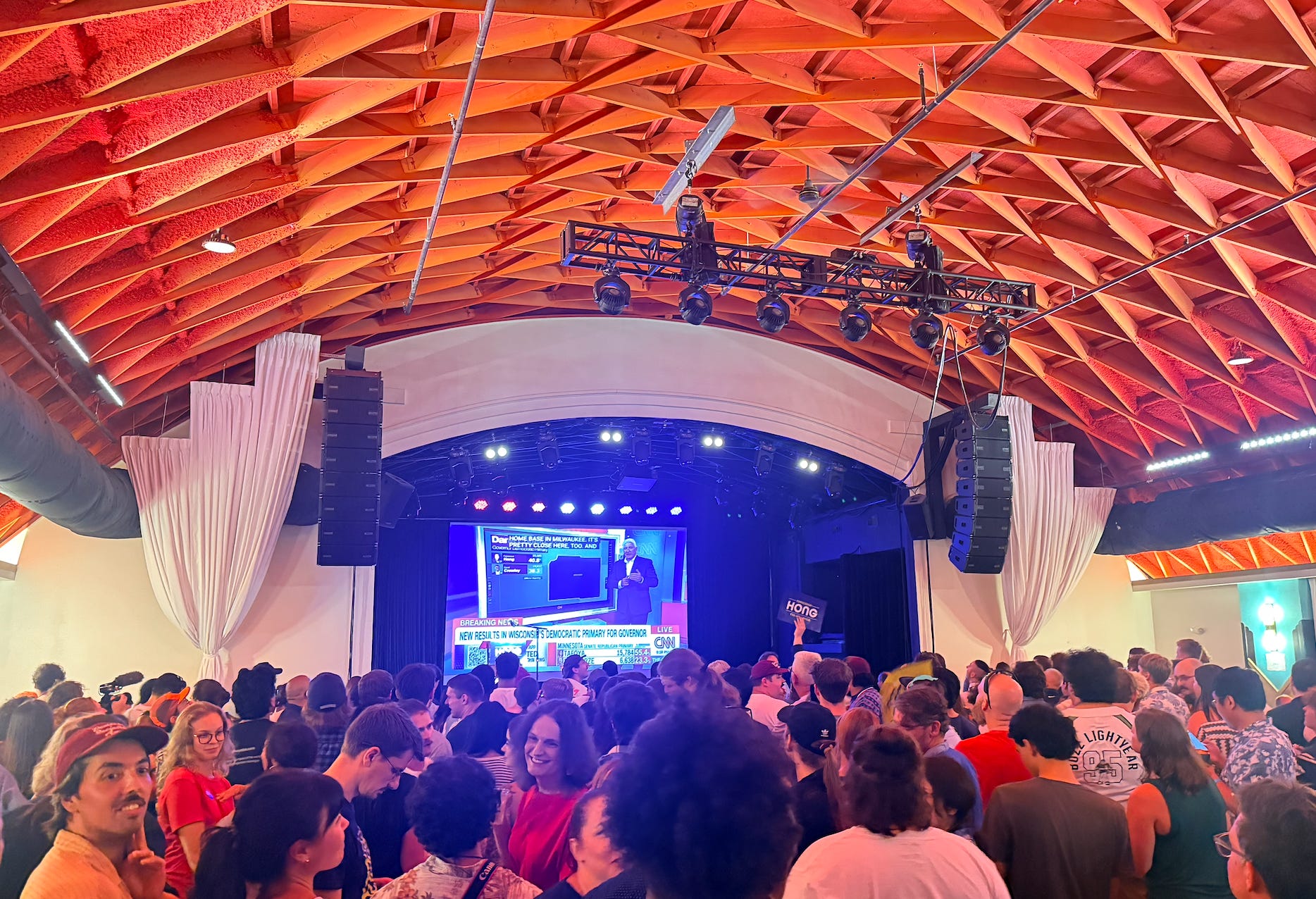
You leave the rally at 11:00 PM. The race hasn’t been called, but the writing is on the wall. It’s an hour’s drive back home to Milwaukee.
You don’t talk about how, when the dust settles, the kind of people who talk about politics like it’s a sport will make all sorts of proclamations. “What does this mean for the battle between establishment Dems and the DSA left?” “Why weren’t the polls accurate?” “Was she a weak candidate?” “Is Wisconsin just not ready for socialism?” There will be takes. By Thursday, the political shouters will turn their attention to somebody else’s state. You and your neighbors only matter to them as proxies in a broader rhetorical war.
Instead, you remind him what it was like to be crammed together in a room where everybody shared the same source of hope, at least for a little while. How electrifying, to jump up and down and scream when the results looked promising. And how it also felt— if not better than at least appropriate— to metabolize terrible news collectively, to feel the weight of defeat descend on a hundred shoulders at once.
You ask your son why this candidate inspired him, about all the ways she felt worthy of his trust.
You share about the first time you learned her name, how years before Francesca Hong ran for Governor, she used to drive across the state in support of Democratic women in long-shot Assembly races. She showed up, and made you realize that you needed to start showing up.
You both reminisce about a couple hours earlier, when it still felt like anything was possible. “Dancing Queen” had just played and the giant video screen showed Fran in the lead. We were winning, at least for a few minutes. The room felt feather-light. So many of the exuberant bodies had been canvassing and phone banking for months. They were exhausted. They deserved this.
You wonder to yourself, what it would be like if your kids didn’t have parents for whom all this mattered so much— not just this race, but so many causes and campaigns. When does a kid switch from caring because they are copying their mom and dad to choosing hope and heartbreak for themselves?
You don’t share that question with him, but you do tell him this:
“I remember an election night when I was thirteen. My mom and dad were stuck in some boring meeting at church, so I sat in the pastor’s office with the tiny desk radio tuned to NPR. I had my list committed to memory— every race I was watching, who I wanted to win. I first kept it all to myself, but it didn’t take long before I couldn’t help it. I sprinted out of the office and burst into the meeting, like some unholy combination of a CNN anchor and the Kool-Aid man. The stakes felt sky high, like the entire world hinged on each decision. But here’s the crazy thing. I couldn’t name any of those candidates today, and I know for a fact that none of them were a quarter as inspiring as the woman whose party we attended tonight.”
You don’t tell him that, as a quixotic political dreamer, you will lose more elections than you win, and then be blamed for your lack of sound judgement. You used to resent those smug recriminations, but you now recognize that politics is a folk religion of dreams and despair colliding against each other. Nerves are raw, and so we are frequently weird and nasty to each other.
Earlier in the night, back at the party, you told a reporter that elections are milestones, but they are not and cannot be the entirety of movements. There is work to be done when your candidate wins, and work to be done when your candidate loses.
You repeat that truism to your son, and he gets it, but he also knows that there is a reason why you both drove the hour to Madison that night. Movements are buoyed by victories, and it would have been so magical to hear Hong shout “WE DID IT!” before imploring us to keep organizing. You are middle-aged enough to no longer quest for revolutions that change everything in the blink of an eye. You get that the work is the point— the relationships, the discoveries, the individual and collective growth. But you also know how your body exploded with joy when “Dancing Queen” played and the numbers flipped.
You remember the rally that you both attended months ago, back when it was still chilly. Fran Hong took the microphone at the brewery down the street from your house. She wore a ski hat and talked about the‘48ers and the abolition movement and the invention of the U.S.’ first kindergarten. You looked at your kids and saw, in them, a long legacy of rust belt idealists. Your son asked you, after the speech was over, if you could please buy a yard sign.
Tonight, you don’t remind him that the ‘48ers were failed revolutionaries, but only in one country. You don’t repeat the facts of their defeat and exile, nor the scores of world-shaking political movements they birthed in the new world.
You don’t get to, because your son interjects instead.
“You know, dad, I know it’s complicated, but I do feel like we’re so much farther ahead than when you were growing up.”
You pull into the driveway, open the back door, and implore your wise-but-teenaged son to please not wake up his sister and his mom. You tuck him in and say the only thing left to be said.
“I loved getting to share tonight with you, bud. I’ll always remember this.”
Thanks so much for this, Garrett. I’m feeling really activated about the midterm elections and this piece was grounding for me. I also recently lost my dad to pancreatic cancer and have been thinking a lot more than I ever did before about legacy and lineage. I find it both awe-inspiring and sobering to think about the ways that the victories in freedom movements are the result of generations and generations of what Ella Baler called “spade” work—working for justice in ways that ready the soil for those who will come after us.
When I was little, my dad always took me with him to vote. After a long line in the gym, sweating in my winter coat, there was a big lever that closed the heavy curtains. When I pushed the lever to reopen the curtains, my dad’s secret vote was recorded! My parents were Goldwater Republicans, raised in rural Nebraska, and all 3 of us kids perplexed and irritated them by ending up progressive. Regardless, voting with them, seeing their yard signs, watching returns come in with Walter Cronkite, arguing about the Vietnam War, created citizens who participate. That seems to me is building the bedrock of democracy. What you did with your son matters.