


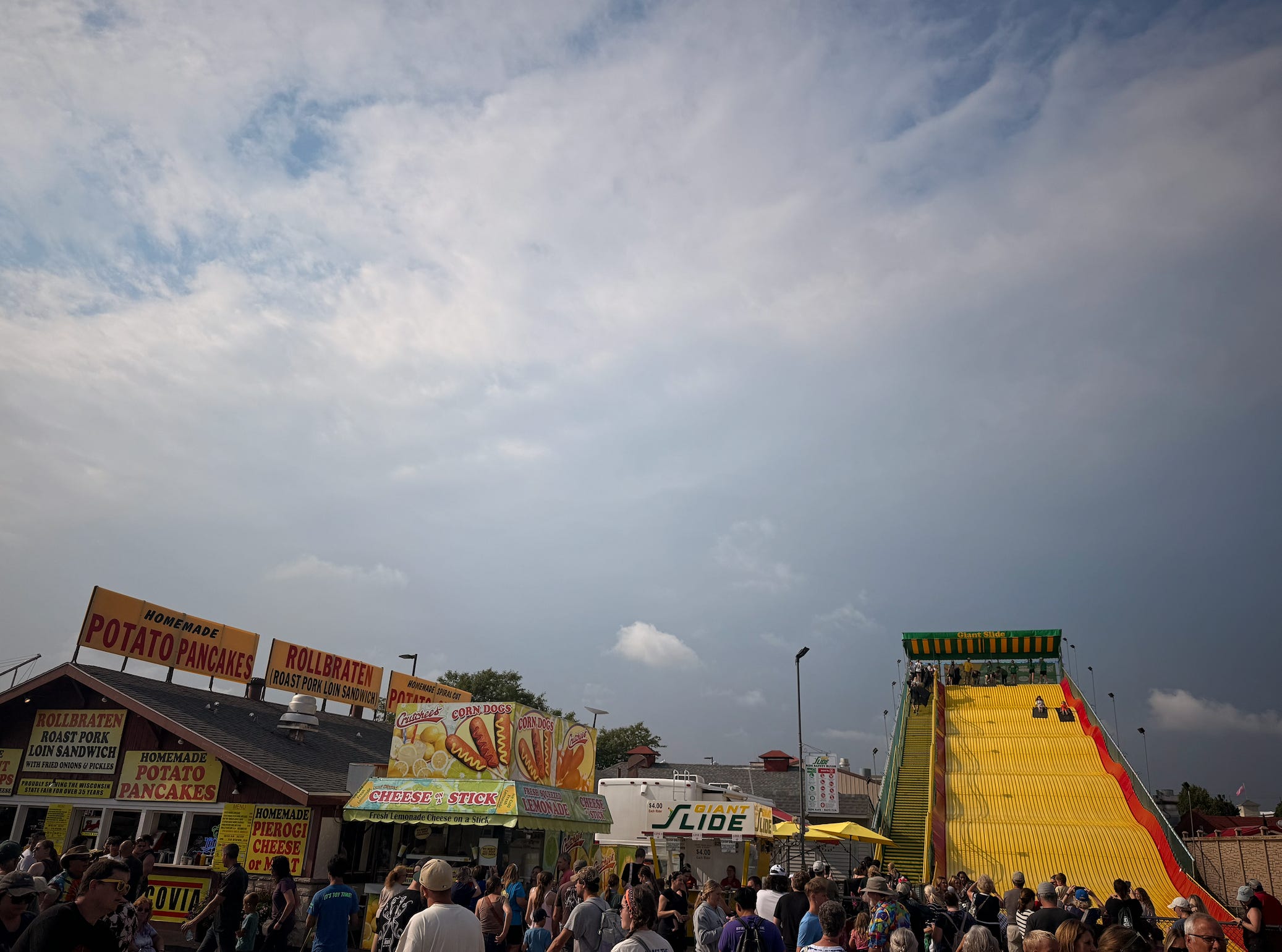
The Wisconsin State Fair is an assault on the senses. It is loud and crowded. Everyone and everything is competing for your attention and your money. The weather’s too hot, except for when it’s way too cold.
It is perfect.
I understand if you do not love fairs. I am married to a very wise person who does not attend the fair with me. I have learned from experience that you can not persuade a non-fair-lover to your side merely through enthusiastic repetition. “But the Sky Rider! But the barns! But the milk house!” I wish it worked.
Somehow even my beloved milk house, that pristine shrine to lactose tolerance, isn’t enough to persuade non-believers. It’s two shacks that used to be sponsored by a Senator but are now sponsored by a personal injury attorney (both respected local figures, for reasons that will take too long to explain). Its promise? Flavored milk at affordable prices, served up by perky volunteers. This year’s varieties were root beer, birthday cake, red velvet cake and s’mores. That’s what you call Wisconsin exceptionalism. You pay at the first shack, pick up your cups at the second, and then huddle somewhere off to the side and opine like some low rent milk sommelier. “Man, that really tastes like a root beer float,” I say to my children, every single year. They respond politely, and then ask to ride the giant slide.
Would you believe me if I told you that the birthday cake flavor was surprisingly well-balanced? A revelation.
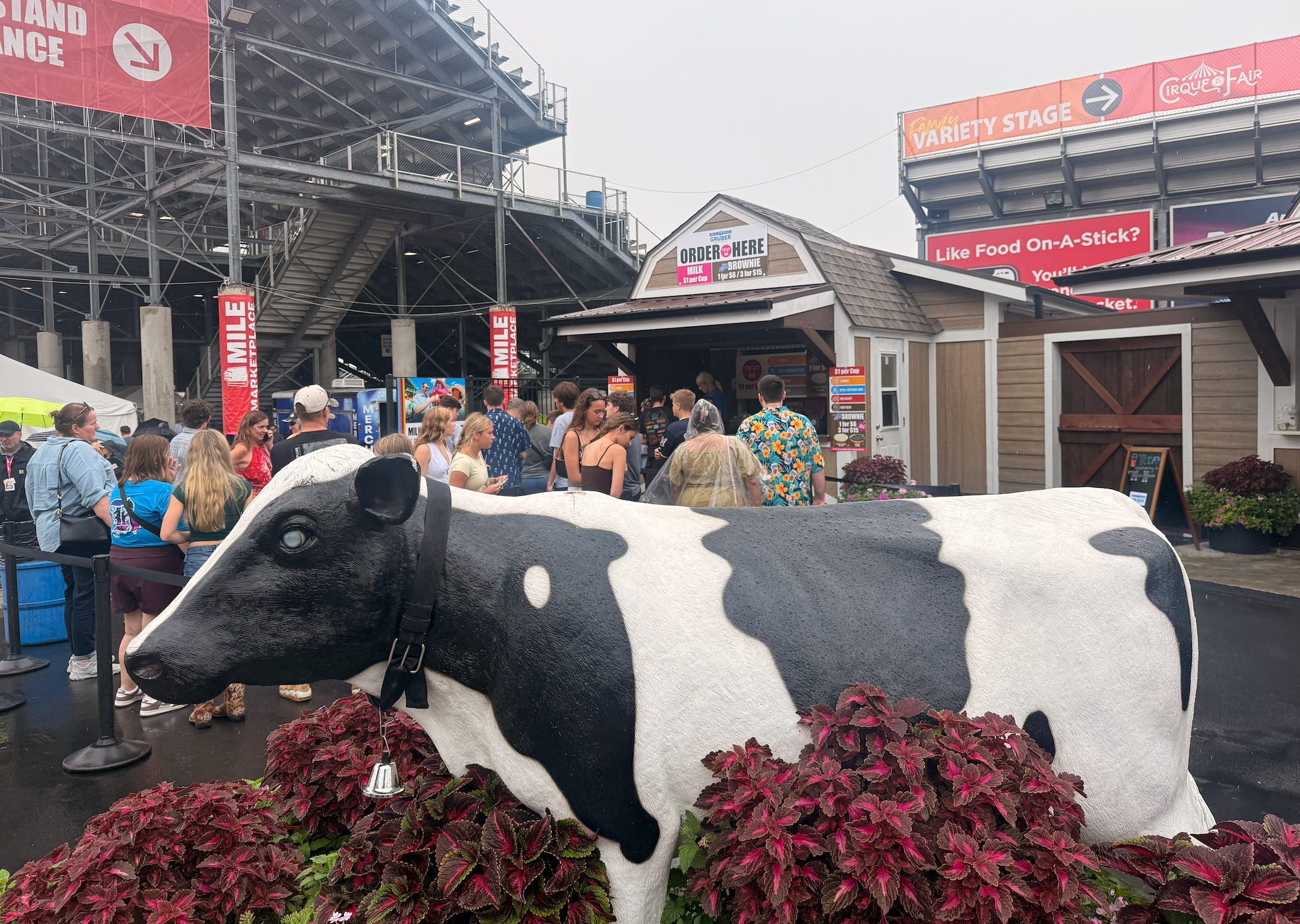
I will shut up about the milk. If you’re not a fair person, that’s fine. If I’m honest, there are aspects of it that even I don’t love. There was a too much AI signage this year. It’s never clear why there are so many hot tubs for sale. On the last night, a handful of bored teens ran around and punched each other on the midway, leading to a predictably racist outrage cycle in the conservative press. Whatever.
I can grant all of that. But still: the fair is perfect, especially the idea of it.
Every year, a community has a party. And not just any party, but a celebration of people’s jobs and talents. Yes, much of the fair’s square acreage is devoted to spectacle– stunt food and “trick the guesser” booths and such. But that’s the point. All the noise and ephemera is in service of something quieter: farm families showing off their livestock; master quilters, jam makers and flower arrangers earning well-deserved ribbons. It is, in essence, a state or county’s way of saying that its residents are worth making a big, loud fuss over.
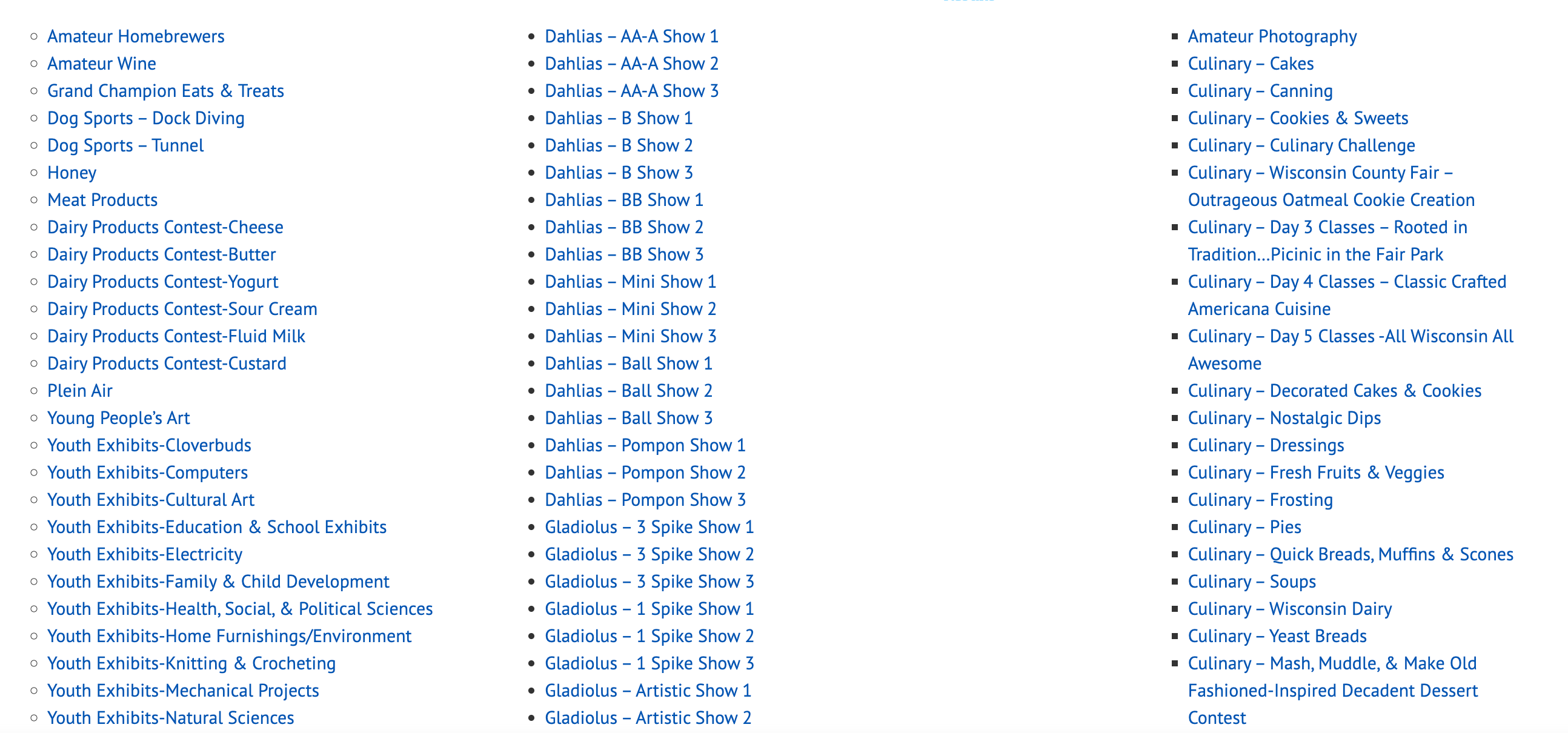
Here is a partial list of judged categories at this year’s Wisconsin State Fair.
Gorgeous.
Somewhere in my state, there are people who can whip up a nostalgic dip that would bring you to tears, or present to you the most gorgeous dahlias you’ve ever seen. Their dogs? They can dive off docks, or do something involving a tunnel. Hell yeah. And you just know that “Dairy Products Contest- Sour Cream” features some heavy hitters.
The fair has always been a love letter to place and people. It’s a celebration of how some of those people make a living, and how some others spend their leisure time. It’s a multi-week exercise in saying “you matter,” punctuated with fireworks, tilt-a-whirls and fried pickles.
Now we are not, of course, a country that celebrates all of its people in equal measure. American agricultural fairs first emerged during an era where there were massive racial barriers to farm ownership. Either implicitly or explicitly, they’ve disproportionately celebrated rural American life. Like so many beloved institutions, there’s value here in asking whose story is spotlighted and whose isn’t.
This, to me, is less an argument for the end of the fair but the most compelling case possible for more of it. It’s time for absolute fair abundance. Every state and county fair should add far more judged categories. Let’s see some mariachi, step shows and Indigenous beadwork next to the dahlias and jam. And let there be more fairs! And more appreciation for the thousands of community celebrations that serve similar functions– pow wows and Pride and Juneteenth and Puerto Rican Day parades. Those too are pristine offerings. Those too will never die. Because again, every fair is a sacred and profane missive to the broader world: the people who live here are worth it. They are fascinating and talented. Did you see their cakes and photography? Holy cow, what work. Let’s eat some corn dogs.
I have spent this past year marveling, as have so many others, as the national backlash against data centers has spread like wildfire. Every explanation, I suspect, is true. Neighbors are worried about noise pollution, skyrocketing utility rates and our water being drained in front of our eyes. We do resent the smugness of the tech oligarchs, their vain assumption that they we’ll roll over at their every request.
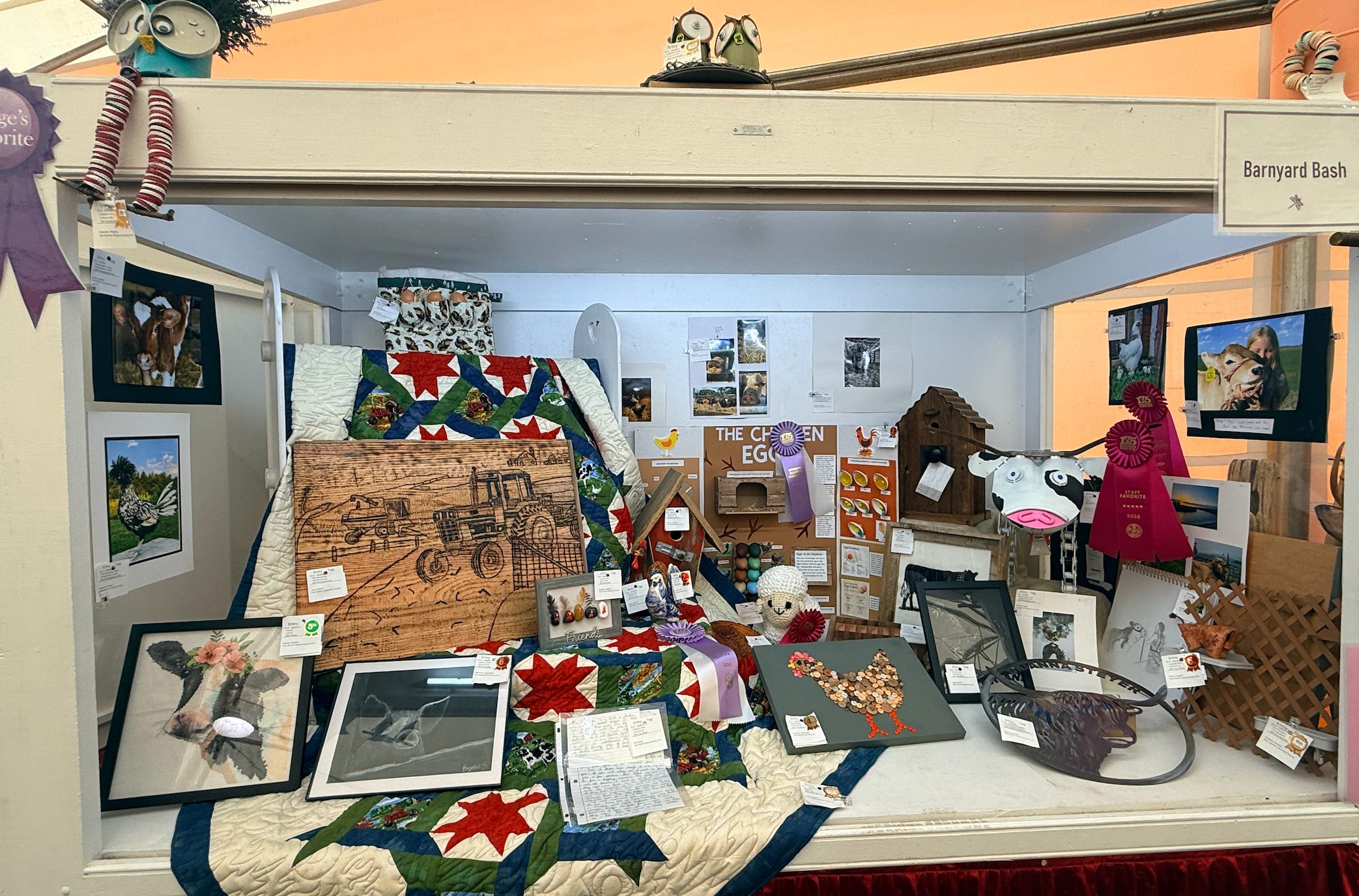
But another piece clicked into place for me at this year’s fair. My kids and I were in the youth exhibits hall, admiring the attention devoted to teenagers’ dioramas and research projects. I didn’t know any of the exhibitors, but I loved that they stayed up late, gluing letters to tri-boards or affixing googly eyes to a cartoon cow.
When you are at the fair, you are reminded that our homes are not just developable land and resources to be exported elsewhere. They are the sum total of our passion and creativity, the moment that our eyes light up when we unlock a new skill, when the quilt that we dreamed up in our mind looks exactly like the finished product, when we taste our buttercream icing and say “holy hell, I nailed it.”
No wonder we hate data centers so instinctually.
Data centers are voids. When a massive corporation “gifts” your community a data center, they are declaring how little you and your neighbors matter to the world as they see it. You are not talented, creative and weird. You do not have people who love and appreciate you for all your quirks. The fact that you live next door to one of their hulking consumption machines doesn’t even register. You are nobody, just like the residents of the last backwater they took over. Your community has land, water, and electricity for their big, dumb rectangle. That’s all. The real work, the smart person work, will be done elsewhere, by people who will still have a job when yours is eliminated.
It isn’t a new story, just another next chapter in the long history of resource colonization and extraction. If you don’t live in the precise place where board room decisions are made, your home has always run the risk of being stripped for parts.
But when I hear about communities across the country packing city council meetings to try to break that pattern, I am reminded of one of my favorite Wisconsin stories, one that’s been told to and by me hundreds of time. My apologies if you’ve heard it already, but it fits.
My wife’s Grandma Pearl was a farmer’s daughter from Marion, WI. Her Grandpa Howie was a plumber’s son from South Milwaukee. Howie fought in the South Pacific during the war, and then briefly lived in New York while waiting for his discharge paperwork. Pearl came up from Wisconsin for that stretch, and together they house-sat a place across the way from St. John The Divine. At some point, Pearl’s parents came to visit, and were treated to a tour of the big city.
I never met my wife’s great-grandparents, but from everything I’ve heard, they wouldn’t have been ones for making a big scene about bright lights or famous sites. At some point, the group found themselves outside of a massive office building right around quitting time. Suddenly, the four Wisconsinites were faced with a crushing wave of people— hundreds of them streaming their way onto the street and towards the nearest subway station. Frank, the quiet farmer from the Shawano-Waupaca County borderlands, just stood there, staring them down. After a minute, he spoke up, softly and slowly.
“Who… feeds…. these… people?”
When a data center comes to town, it delivers a message: Not only do you not matter, you barely exist.
When we gather at the fair, we respond. We exist, and we are not alone. Who feeds these people? Who clothes these people? Who cares for their children, or inserts their IVs, or drives their buses? We do.
The urgent project of this particular moment– when we increasingly long for connection and belonging while growing more suspicious of big tech— is to help each other make the connection between the community celebrations we love and the death stars we resent. It’s why I’m a state fair socialist, a potluck socialist, and an ice cream socialist. It isn’t enough to shout down capitalism if we don’t match it with trust in and awe of our neighbors.
The lines, of course, are never clear. We’re all implicated in this economy, even when we wish we weren’t. The modern state fair is, in practice, not a utopia set apart from the world. It’s filled with money changers and hucksters (and again, ironically, AI). And of course, there’s a short, tenuous walk between agrarian nostalgia and reactionary anti-populism. But none of that is why we love fairs. None of that is why they persist. We desperately want to celebrate each other, and to have a good time in public.
Likewise, we don’t just hate the data centers because our utility bills are going up or our water is being guzzled by robots, but because of what they represent: the absence of humanity, a giant hole that gobbles up community and spits out profit.
Our yearning for each other, for a shared life that matters, has always been the most inherently political thing about being human. The trick is in naming it.
I love how much we hate those big dumb rectangles, almost as much as I love how much we are drawn to the fair. There is not one narrative of connection and another one of resistance. It’s one story.
So bring on the fireworks, the tilt-a-whirls, the food on the sticks. Show off your life’s work. Make a scene with your neighbors. The robber barons want you to believe otherwise, but your world is not a wasteland. It’s loud and messy. It’s sticky and deep-fried. It sounds like a cover band hitting the high notes in “Don’t Stop Believing,” or the shriek of a ten-year-old who just won the giant panda at skee ball. One minute it’s all flashing lights, the next a quiet hall filled with quilts. It is perfect.
End notes:
Like many artists, activists and writers before me, I make a living based on passing that hat. In the time that I’ve been writing, I’ve never raised the price but I have added quite a few more perks. That’s because I’m sincerely grateful for everybody who helps out, and I don’t take it for granted. Thanks in advance for considering pitching in! What a gift!
If you’re curious as to my milk rankings this year, they’re here (that’s an Instagram link). Also, you’ll notice that I did not talk about Cream Puffs, which are generally considered to be the official food of the Wisconsin State Fair but which, objectively, are merely fine.
In past years, I’ve done a summer movie series featuring a series of guest essays. It was super fun, but I held off this year (it was just too much to manage with the relay, and I also didn’t want the idea to get stale). The downside of that decision is that a few essays have come my way that, absent the movie series, I haven’t gotten to share with you all. Fortunately one of the best I’ve ever read, this piece by Jasmine Mote about trans-racial adoption and Hedwig and the Angry Itch, was just published at Emily St. James’ (terrific) newsletter, Episodes. Oh my god I hope you read it. So good.
Most of the the other announcements for the week (fun relay updates) are at the bottom of Tuesday’s piece. Pretty personal essay, that one. Felt more-vulnerable-than-normal sending it, for reasons I can’t quite put my finger on, though I’m glad at how it turned out.
If you do not live in Southeast Wisconsin and believe that your state or county fair is better than mine, I love that for you. Minnesotans and Iowans, I know you in particular have strong opinions, and you’re probably right. I can’t wait to see your fairs in person. Save some milk for me.
As a final treat, here are some cows, underneath their respective county’s displays. Also a picture of me staring down a fake cow (and losing). There are no pictures of data centers, because they are ugly.


"There are no pictures of data centers, because they are ugly."
Word.
Living in a state capitol, the State Fair each October (it's finally cool enough to survive the hours on cement) is a HUGE deal. For some it's the sand sculptures and art competition buildings. For the kids it's rides, funnel cakes and a couple weeks when teachers don't even pretend to teach cuz the kids just aren't there. The smells back in the barn areas beg for nose plugs. Every year there are more fried options. The entertainment each evening brings back the best of nostalgia and ear plugs. I used to force myself to go cuz friends had entered one competition or another, cuz the fried turkey legs were awesome, but it just wasn't enough to get me through the rest of it. Yes, it brings community together, and many epic things occur, but I think some of it must be age and gender connected. Glad it still works for so many of you.