

Our political movements should be better at organizing than the average megachurch
But we're not there yet


Let’s say that you’re trying to organize your community. Maybe you’re all in for a candidate who inspires you, and you wonder why your friends won’t canvas with you. Maybe you invited your friends to a vent session after the last election, but the energy fizzled by December. Maybe you know the unique indignity of a circle of half-filled chairs. At some point, you’ve likely bemoaned your neighbors’ flakiness, how they never actually seem to walk the walk with you.
Or let’s say that you’re not an organizer, but you have a long list of events in your area that you always mean to attend. You show up once but never again. Maybe you’ve gotten down on yourself for the commitments you’ve flaked on, wondering why you always get in your own way if you are craving solidarity and connection.
Why indeed? I mean, if it’s stone-throwing time, I’m happy to offer up my own glass house as tribute. Despite literally writing about civic engagement for a living, I too have a real track record of not sticking my neck out for my community. I can name, off the top of my head, at least a half dozen values-aligned political groups in my area that I haven’t engaged in any meaningful way. I have met the neighborhood flake, and he is me.
Like all of us, I have some good reasons for preemptively bailing on unfamiliar political spaces. I’m a busy parent, with plenty of constraints on my schedule. I’m literally hosting fifty events across the country. Self-effacement aside, I’m involved in plenty of political projects. I’m trying not to over-commit. But in the grand scheme of things, those are fairly minor barriers. Because of the particular confluence of my identities, I’ve never really experienced a space that was structurally inaccessible to me. I’ve got my excuses, but are they good ones? Debatable. I could definitely be spending more evenings sitting on folding chairs, chopping it up with other idealists.
So why am I a frequent feet dragger? If I’m honest, my answers are mostly banal, embarrassing, and, I suspect, not uncommon. I don’t quite know what to expect, were I to show up to a meeting, so my dumb brain fills in the gaps ungenerously. I assume that my time won’t be stewarded well, or that breaking into an established social and organizational infrastructure will take too much effort. I weave stories of preemptive rejection (depending on the space, I worry I’ll be either too old or too young, too radical or not radical enough; in every case I assume I’ll be an overly earnest galoot and nobody will laugh at my jokes).
Again, not helpful, but extremely human. One of the core paradoxes of social psychology is that we are profoundly communal beings saddled with an equally strong evolutionary fear of rejection.
There are, however, spaces that do a better-than-average job of getting their community to show up in practice. And please forgive me for tiptoeing into rhetorically tricky territory here, but I want to discuss evangelical megachurches.
You’ll notice that I’m choosing my words carefully. There are no doubt some reading this who have found positive community in megachurches (which, for our purposes, I’m defining as those 1000+ member Christian churches that have accounted for most of Christianity’s growth worldwide over the past thirty years). There are also, no doubt, a great many of you for whom these spaces (particularly within white evangelicalism) have been anything but welcoming in practice. I’ve got plenty of political and theological critiques of the median American megachurch, especially when it comes to gender and sexuality. It breaks my heart that far too many megachurches, in practice, strengthen rather than challenge societal hierarchies and wounds.
Megachurches aren’t utopian communities, but they are people magnets. Since evangelical Christianity’s key mission (whether you agree with it or not) is to bring more people to their faith, it would be arrogant for left-leaning political organizers (whose job, similarly, is to bring more people into political movements) to have zero curiosity about whether they offer applicable lessons for us.
Most explanations for the growth of megachurches focus on a two key elements: the pageantry and high production value of the worship services, coupled with the intimacy of small groups. This all tracks, from a social psychology perspective. The stadium-sized multimedia services make people feel as if they’re part of something bigger than themselves, while the small groups offer a sense of belonging and accountability.
Both of these organizing moves matter, and I’ll likely explore their applicability to political organizing in future essays. But neither the spectacle of the service nor the intimacy of the cell matters if people don’t show up the first time. And while the reasons why a believer might be drawn to an evangelical church might differ from why a new activist might raise their hand for a political campaign, both have to overcome the same obstacle: human beings’ fear-filled, excuse-making brains.
Here’s what you see when you arrive at the website for Eastbrook, one of the largest megachurches in my area.

Having a dedicated“I Am New” homepage may seem like a trivial choice, but it’s impactful. Let’s say I was personally curious about attending Eastbrook Church. I’d likely have all sorts of questions— what would be asked of me when I arrived, how I’d be welcomed, what to do to ensure I didn’t make a scene. These are the kind of evolutionary curiosities we’re always asking when we evaluate whether a new space will be worth our time, and Eastbrook knows it.
Scrolling down just a bit from “I Am New,” I’m immediately greeted by another prompt: “What to expect at a worship service.” This, in turn, leads to all sorts of answers. I first learn that worship will last exactly 60 minutes (helpful!) before being directed to a list of FAQs that read, notably, like a list of actual questions new parishioners might actually pose, not just another place for the church to Trojan Horse its mission or values into another corner of the website.
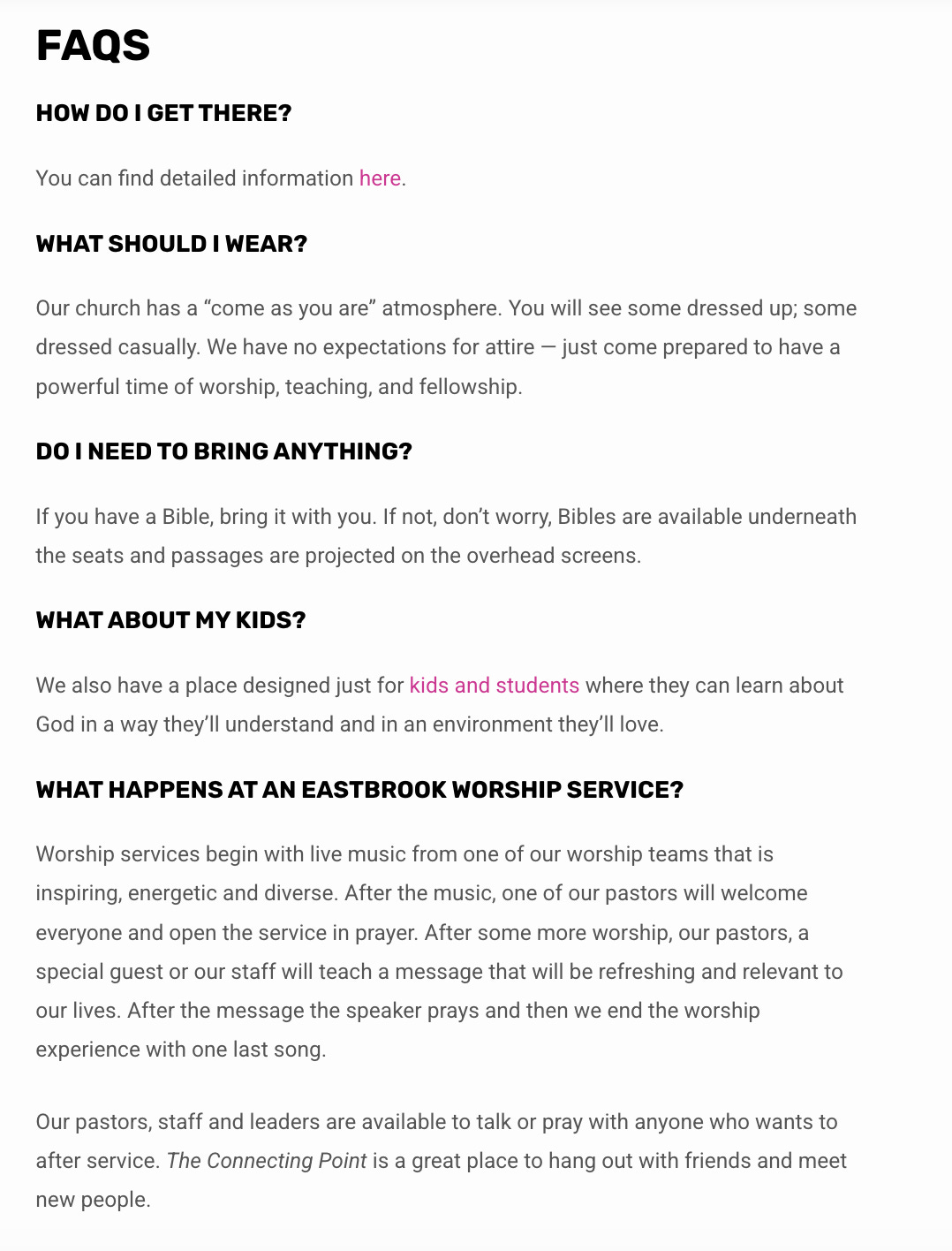
Remember, we’re not evaluating Eastbrook on the universality of its appeal, but on its ability to help the already curious take that first anxiety-ridden step through the door. And honestly, it’s passing that test with flying colors. In just a few paragraphs, I know what to wear, what to bring, who will take care of my kids, how long it’ll take, and a physical location in the church building that I can go to if I have further questions.
Now, let’s compare that experience to what happens when I navigate the websites for some of the local activist groups whose meetings I probably should but don’t attend. In the interest of equal opportunity feedback, I’m deliberately picking organizations across the progressive political spectrum. There are plenty of lessons for the socialists and the liberals here, because both groups are legitimately interested in expanding their appeal. The more mainstream liberal groups worry about being too old. The more leftist ones recognize that they haven’t broken through with non-college-educated neighbors. They’d both love to have new folks come through the door.
Let’s start with my local Indivisible chapter. Their website has no corresponding “I’m New Here” page, but there is a list of upcoming events, including one that genuinely looks like a lot of fun.
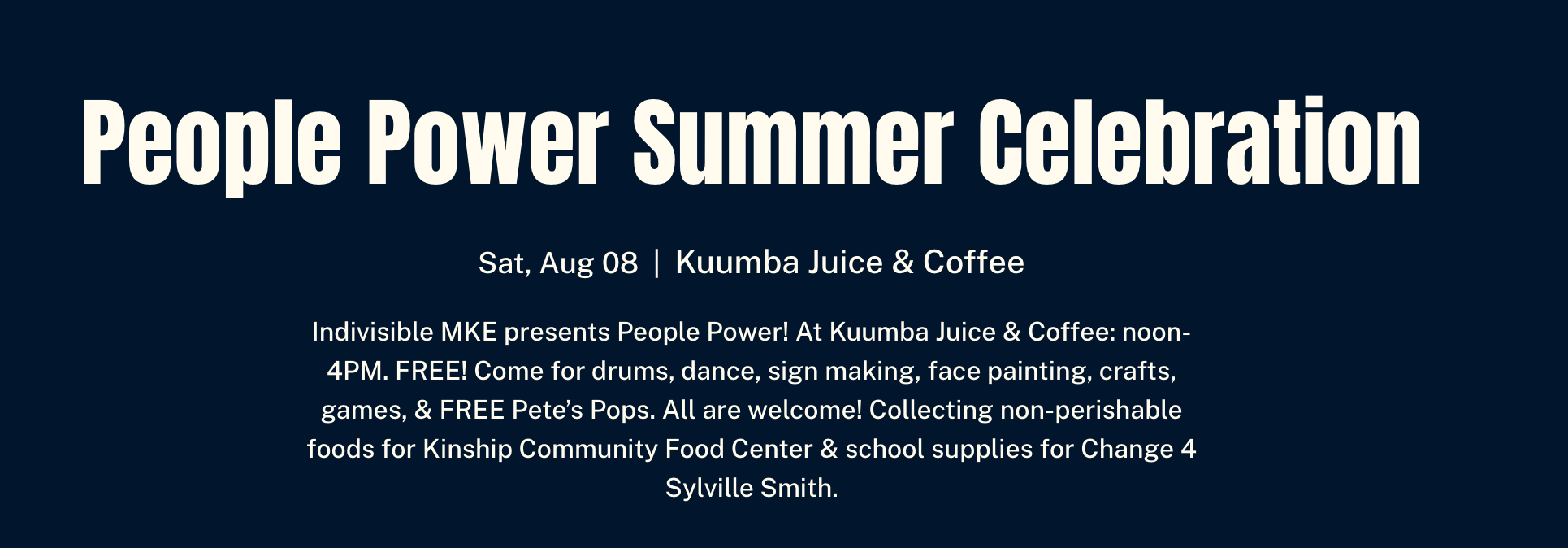
We’re off to a solid start. I can tell the vibe is going to be celebratory, and there’s a truly impressive list of (presumably family-friendly) activities. This definitely speaks to an organization with cross-generational ambitions.
But here’s what’s lacking. I still don’t know how I’m supposed to engage in this space. Am I supposed to be there for all four hours? If not, will the activities last the entire time, or just a portion? Are these rotating centers? Or individual workshops? Am I expected to drum, or just listen as others do so? Which of these activities are specifically designed for kids? And if I do bring my children, are they supposed to stay with me or will there be separate activities? Will we get a popsicle regardless of when they come, or just at specific times?
Those might sound like pedantic questions, and they are. But that’s because the human mind is frequently a world-historical pedant. As a general rule, human beings are desperate seekers of pre-event clarity— not because we actually need answers to every single question, but because those answers signal whether a given space will welcome and keep us safe. The Indivisible crew is clearly doing so many things right— I can tell that this is an event designed with intention. But if the goal is a truly open door, there’s still room to grow.
A similar, if even starker, pattern emerges when I navigate further left on the local political spectrum, to my area’s Democratic Socialists of America chapter. That homepage features plenty of pictures of members marching and raising their fists, but not much in the way of a welcome mat. The “Join DSA” button immediately whisks me off to start paying dues, which feels a bit presumptuous for a newcomer. Once again, there’s no clear “I’m New” page, but there is a subheading urging me to “Get Involved.” Not bad. I scroll down, and am greeted by the following explanation/invitation.
Milwaukee DSA offers a myriad of ways to participate. We have working groups, committees, caucuses, and coalitions, as well as campaigns. We invite you to find a group or campaign that focuses on topics that you are interested in and reach out to them to get involved! You can find out when meetings are on our calendar. To learn about specific work that the chapter is doing, see the group pages linked below.
If I’m being honest, that too feels like a big ask for somebody who is entirely new to the group. It could work, as long as the website offers transparent descriptions of what each working group does, when they meet, how to participate and why their efforts matter to the broader work of the chapter. Unfortunately, things take a turn for the opaque pretty quickly.
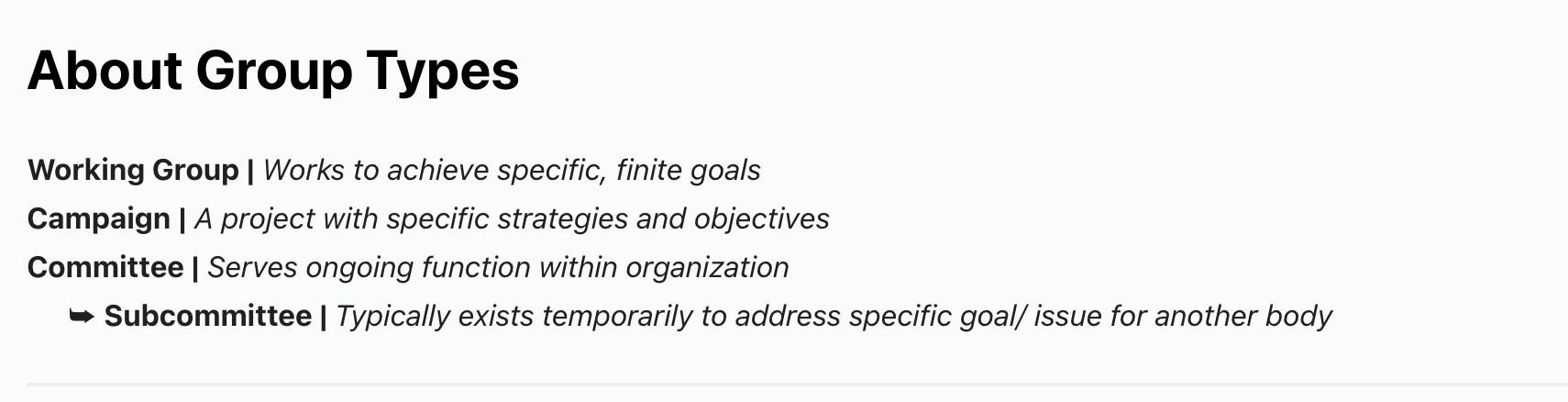
Oh jeez, that’s not helpful at all. What’s the difference between a group that “achieves specific, finite goals” and a project with “specific strategies and objectives?” And what does it even mean to “serve ongoing function within organization?” I’m truly not trying to be rude, and I bet I could figure it out if I tried, but it begs all sorts of questions. Who is the audience for this? Will any of it actually be useful to a potential new member, or does it inadvertently signal that this is an insider-y club with a high barrier to entry?
The deeper I scroll, the fewer answers I’m provided. The rest of the page features profiles of the various groups I could join. The graphics are bright, but the messages are muddled.
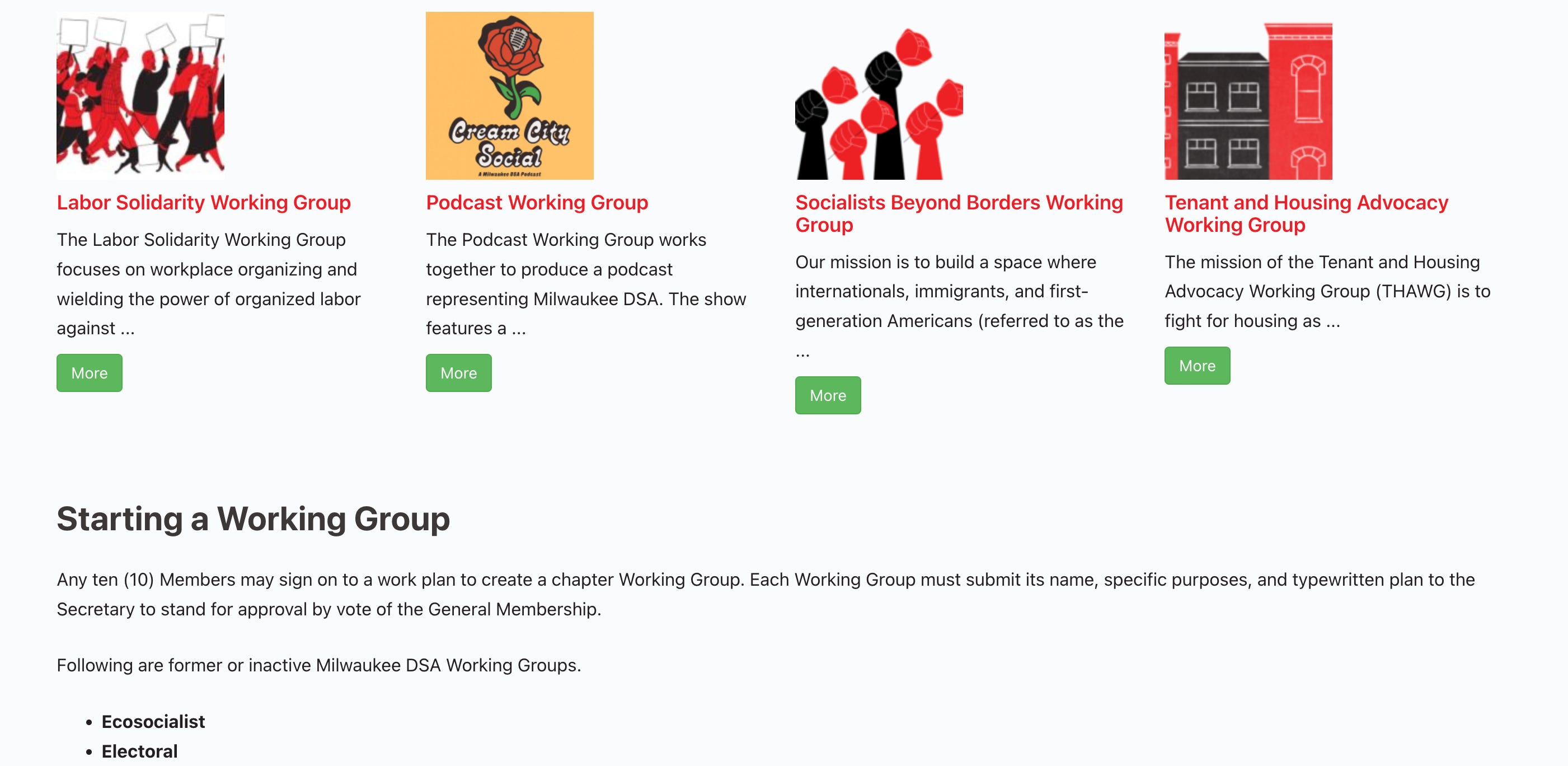
Wait, what am I supposed to do again, as a new member? I was just told to join a working group, but when I try to do so, I’m greeted by a jumble of haughty statements and disconnected prompts. When I click on the Labor Solidarity Working Group button, all I find is a manifesto, another donation link, and an email address. Is that how I’m supposed to join? And what am I supposed to make of the entreaty to somehow find nine other socialists (where?) and start a brand new working group? What if I just want to come to my first meeting and I’m nervous about what it will feel like?
All this would be akin to Eastbrook’s “I’m New” website offering no information on how to attend a weekly service, but instead just a long list of potential small groups (each one with limited information about when and where they meet, and what they do in practice). Or worse, if they told me “find nine Christians, start your own small group and then get back to us.” There’s a reason why the membership flow at places like Eastbrook eases newcomers into participation rather than throwing them off the deep end: after a new member shows up at a worship service, a staff member or volunteer reaches out, learns about the potential new member and their interest, and then helps them plug into a small group. And more importantly, newcomers can expect all that will happen, because that too is all laid out on the website (under the heading “What’s Next”).
I’m highlighting this distinction not to beat up on these two organizations. I could have picked just about any left-leaning organization and found a similar pattern. Heck, I’m sure there’s a lot of room for growth in the effort I’m currently running. I’m sympathetic as to why we don’t have the time or space to do better here. Our organizations are stretched thin, and almost universally run by volunteers. Megachurches have a small army of paid staff.
The good news, for our movements, is that none of these steps are all that complicated. You could incorporate them into your next welcome email or text message invitation tomorrow. They do, however, require a specific paradigm shift, one that institutions such as megachurches currently understand better than the political left does: People aren’t actually that curious as to who you are. They don’t need to see your bylaws or mission. They don’t need proof that you’ve led fifteen successful campaigns. If they’re considering showing up to your space, they’re much more concerned with how you’ll welcome them— will they be greeted warmly, will their questions be answered, will they be given clarity as to how to participate well in the group.
The lesson here isn’t that progressive political groups should just copy and paste their websites from megachurches. It’s just to change your perspective. If you’re the host of a space, don’t talk to the already committed, or to those who’ve already successfully navigated your space. Instead, channel your own newcomer instinct. Picture yourself showing up, nerves high, to another space. What would you want to know? What information would put you at ease? And then, once you show up, what would help those anxieties dissipate?
Human beings are diverse and complicated, and no doubt have a million individual reasons for flaking on new commitments. But we’re almost always anxious. We know that showing up will eventually require a leap of faith, but we also hope, if at all possible, that a new group would care about cushioning our fall.
I don’t believe that all megachurches are stronger communities, in the most holistic sense, than anything we can offer of the political left. At least now, though, they are better organizers. That shouldn’t be the case, given that organizing is supposed to be what we're all about. But there’s no time like the present to catch up. The next new member doesn’t need to know we just dusted off the welcome mat yesterday. All they care about is that we show, in our actions, how glad we are that they came.
End notes:
In the spirit of my essay, here’s what happens when you become a paid subscriber of The White Pages. First, you’ll get a thank you message, which includes a link to request your free thank you gift (a t shirt, poster or hat). Then, on Fridays, you’ll get an email inviting you to one of our weekly discussions. You can either lurk there or participate (either is great) but the goal in either case is to support each other, build virtual community, learn from one another, and laugh at some pretty good jokes. You’ll also get an invitation to a Discord, which you’re welcome to join, if you want to hang out with people beyond just a single weekly discussion. Meanwhile, what you’ll be paying for is my ability to keep offering all of this— essays like this, coaching for organizers, and the Interdependence Relay. A pretty good deal, if you ask me.
Speaking of the relay, are you in the Helena, Montana area? Well, you’re in for a treat. Tomorrow night at 6:00-9:00, there’s going to be a potluck, a celebration of migration. And there’s a terrific organizer who's in charge of it (Amber) and she’s happy to walk you through everything you need to know (where to go, what to bring, etc.). All you need to do is text her—406 594 2107. That too is a pretty great model for welcoming people into a new space (and making sure al their questions are answered).


As someone who does communications work professionally, this is SPEAKING MY LANGUAGE. So often, organizations fail to center the audience in the way they approach these things - too much inside baseball language, too many assumptions that if people are motivated by the mission, they'll just figure it out and it will all be fine. (As you point out, it definitely will not all be fine).
This has also given me a lot to think about as I just today agreed to join a group that is planning our community's response to potential ICE raids (I live in a heavily Hispanic community in the NY suburbns, so this feels somewhat imminent) and I want to figure out how to engage as many people as possible in this incredibly important but also, if we're being honest, scary work. I would love to hear from others who have done this successfully in other places that have been pushing back against ICE - feel free to DM me if that's more comfortable.
I don't know. Reading this makes me realize that there is a big gulf of divergence of what is occurring at a megachurch and what is occurring in activist political groups.
First of all there is the shift of focus, the megachurch is actively focused on trying to make the person feel welcomed and included as part of its core ethos. If there is an agenda, the agenda is hidden behind issues that are meant to serve the people in the community.
Activist groups are often focused on trying to make progressive change and as a result are usually focused not on the people that are joining the cause but on trying to change a power structure. Learning from the megachurch the activist groups should need to take a different approach and look to try to serve the people who are joining the cause and not simply look for people to join their cause. It's a significant difference.
A core part of this is the ethos of some of the activist groups, the ethos is about trying to change a system to serve the people they are advocating for, vice building a system that is actively serving the people they are advocating for.
As a result a lot of left-leaning activism can become a bit disembodied and become overly cerebral in its approach causing an impact with the relationality. The megachurch does the exact opposite though, it focuses heavily on trying to reinforce relationality but individuality is what is sacrificed in the process.
I think in order to really learn lessons from megachurches there is a need to really develop an ethic of showing care to the people who are part of the effort and not just advocate for state-based systems that will do the care on their behalf.