

Everything is possible and nothing is pre-ordained
And who knows, maybe this year you and your neighbors will surprise us all

Would it make you more hopeful if the worst parts of being alive were inevitable? Would you feel more empowered if everything that grinds our gears— a world run by a greedy and capricious few, the persistence of caste and violence, all the ways we’ve ripped apart what tethers us to each other and our planet— were the result of some cosmic law and not merely the downstream runoff of so much inherited nonsense? I don’t think so. As painful as it is to wrestle with the truth that human beings chose all this, it would be far more unbearable if we had no say in the matter.
I am publishing this on January 1st, 2026. A new year. Choose whatever metaphor you want: a blank slate, an empty page, a cherubic baby. I have no promises or predictions, save for one. Nothing about 2026 is true yet. This could be a year of more tears or more celebrations in the streets. We don’t know. And granted, the slate isn’t actually blank. Whatever road we walk on in 2026, we do so on existing terrain. We don’t begin a new year with freshly toppled regimes, or a different economic system, or with any of our individual failings and peculiarities washed away. New year, new us? Not even close. We’re stuck with each other. But the point remains. Anybody who tells you that “2026 will be the year of _________” is, at this point in time, a liar and a charlatan.
We are told so many stories about what is going to happen. In 2025, we were told that there was no point in resisting Trump, or AI, or a world where the only voices that mattered were roughly a dozen men with podcasts and creatine dependencies. Maybe some of those stories are still true. Lord knows there are powerful forces fighting like hell to make them appear true. But I hope you discovered, this past year, how much more joy there is in a life where we act as if none of this is pre-ordained. We don’t have to give our money to corporations who hate us. We don’t have to accept the authority of a state that disappears our neighbors. We don't have to cast anybody to the curb just because a pundit told us that nobody cares about strangers anymore.
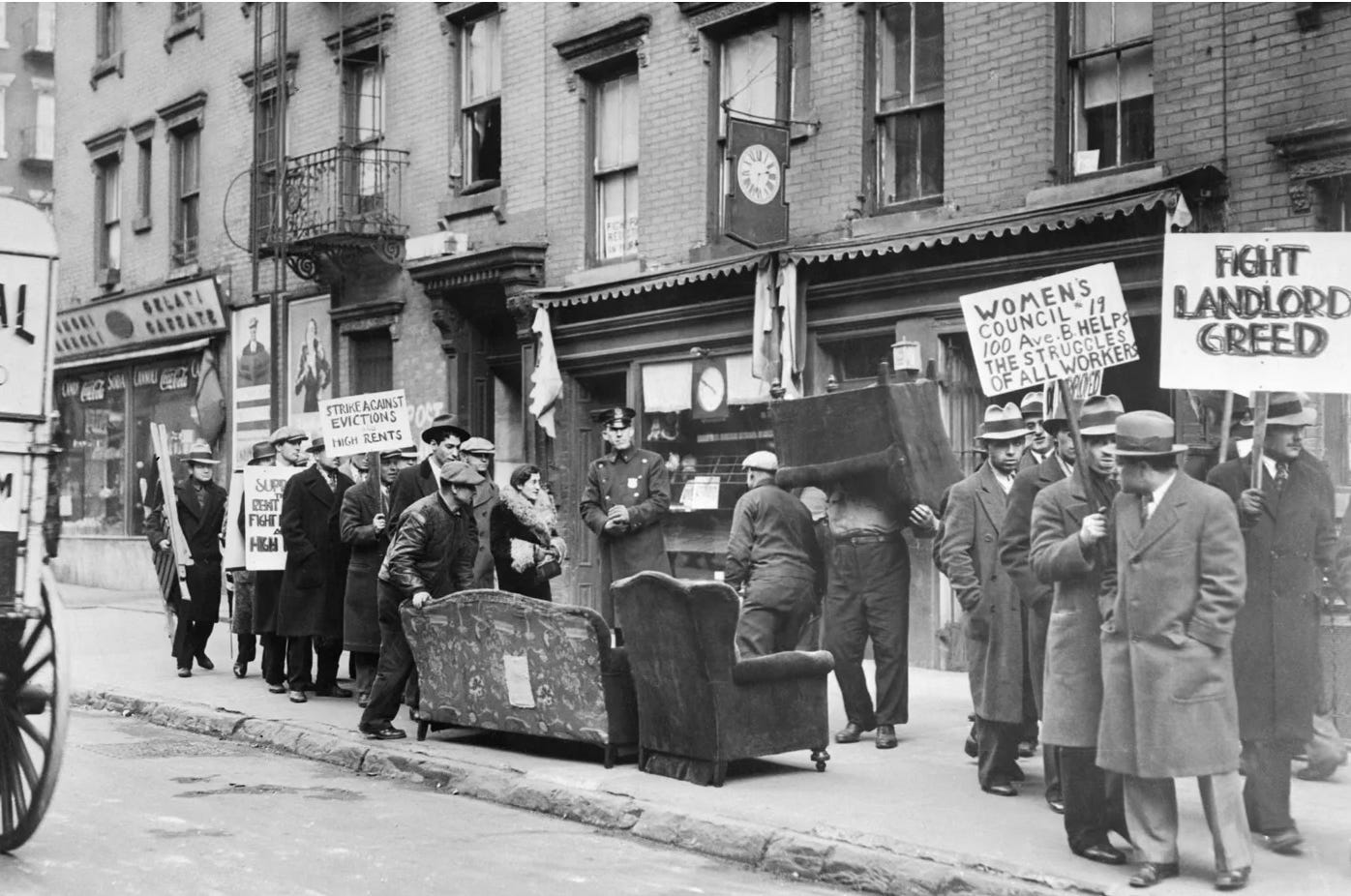
Here’s a different story. Not a speculative one. An actual story, from a not-so-distant past. During the Great Depression in the United States, as millions of lives were upturned just because the stock market crashed,1 a network of Unemployed Councils blossomed from coast to coast. Organized by various competing Communist factions, they failed to catalyze a single grand revolution, but succeeded in seeding hundreds of tiny ones. Cooperative networks in cities like Oakland and Compton launched sophisticated webs of urban farms, lumber mills and machine shops connecting hundreds of thousands of neighbors to each other. In Seattle, the unemployed league first built an alternative municipal government, then essentially took over the conventional one, getting permission from the city to distribute government aid where it was needed most. In every case, there was no precedent. They just did it.
I understand the counterpoints. Those were different times. The vibes were dire. People had no choice but to turn to each other. But think about how often we’ve been told that the opposite is true, that as conditions around us grow worse, we will inevitably grow more timid and caustic.
In New York, unemployed councils were strongest in Black and Jewish neighborhoods, the same ones being hit hardest by evictions. That was the old story, of cops serving capital. But that story was met with a new one. The landlords and police would show up to kick a family out of their apartment and be immediately met by a crowd of determined neighbors. Often women-led, the assembled gatherings hollered, made a scene, and physically barricaded buildings until the authorities gave up. If they failed, if a family’s gatherings were in fact tossed out onto the curb, the crowds covered them in tarps, waited for their adversaries to leave, and then pried open the boarded-up door so that they could move everything back in again.
Evictions, they discovered, were made-up stories. Or they were, at least, as long as the counter stories were told by a sufficient number of neighbors, with enough love and persistence to lay bare the ludicrousness of the first narrative— the one about how only some people are entitled to a safe place to live.
I frequently tell stories like this, so I’m no stranger to how they land. Surely, we tell ourselves, there was something different about those heroes of the past. They were made of something that we aren’t. Bolder, flintier stuff. Couldn’t be us. The only stories we believe about ourselves are tales of nihilism and presumptive failure. That social movement business works somewhere else, but we’d surely muck it up. In our towns, you see, all the existing activists are annoying and all the strangers are either hateful or apathetic. We tried solidarity once, and it failed. Or we never tried it, because we knew it would fail. It’s harder now, you see. We have billionaires. And phones. Have you heard about he phones? Everybody’s glued to them.
But do you know what happened in New York City, in 2020? The same thing. Neighbors gathered outside apartments and made a fuss. Scores of evictions were stopped in their tracks. Families stayed in their homes. That was in our shared reality, not a halcyon past.
Here’s one last story. And you’ll have to forgive me, because it’s from the Montgomery Bus Boycott, an overly dipped-into well of activist parables if ever there was one. This one isn’t about superheroes, however. It’s about people who weren’t merely imperfect, but who often didn’t even trust each other.
Before Rosa Parks became a household name, she attended a two week organizing training at the Highlander School, the legendary activist retreat and education center in rural Tennessee. I’ve known that part of the story for years now. What I’ve only recently learned, though, was how she spent her time there: Talking trash. Complaining. Bemoaning the potential for any meaningful activist movement back home in Montgomery. Parks was grumpy, but she had a point. She knew, from both her and her husband’s history in union organizing, that Black Montgomery wasn’t fertile movement territory. The town’s Black churches were both cautious and consumed by petty rivalries. Residents of leafy middle class Black neighborhoods looked down on their working class counterparts across the tracks. Nothing meaningful had ever happened in Montgomery, and so there was no logical reason to believe anything ever would.
A few months later, after the boycott she catalyzed was in full steam, Parks returned to Highlander aglow. Montgomery, she reported, was a different place now. She and her neighbors were making history. The class borders they had erected between themselves were more permeable than previously assumed. They were organizing, for real. The cast of characters was the same. And they were still complicated, imperfect people. They hadn’t permanently parked their egos permanently at the door or stopped getting in each others’ way. But now they were trying, and the trying made the difference.
You hear a lot of these stories, if you study social movements. This or that town was the last place where anybody would expect history to be made. This or that country would never topple a dictator, until suddenly they did. This or that organizer wasn’t the right person for the job. They were too introverted, too cynical, too scattershot, too human. And then, wouldn’t you know it…
Which is all to say, I suppose: Happy New Year. You are the same people you were last year. So too are your neighbors, be they ride or die best friends, disappointing known entities, or distant strangers that you’ve always assumed will stay that way. When the clock struck midnight, none of you transformed into beatific community builders. You’re no better equipped to be kind and audacious to one another than you were a day ago. But also, you haven’t tried 2026 yet. And who knows what you can be to each other this year. Who knows how you’ll surprise us. Who knows how you’ll surprise yourself.

End notes:
If you’re interested in learning more about this wrinkle in the Montgomery story, I highly recommend Jeanne Theoharris’ classic The Rebellious Life of Rosa Parks. For more on the unemployed councils, check out “The Depression and the Urban West Coast” by William H. Mullins (published in the Western Historical Quarterly) and Mark Naison’s Communists in Harlem During The Depression. For a compelling introduction to both stories (and others), you can’t go wrong with Linda Gordon’s Seven Social Movements That Changed America.
Thank you for being here in 2025. Because of this newsletter, I both deepened connections to many of you and made a ton of new ones. The webs are thicker between us, (and spread out in more directions) than they were a year ago. What a gift, and I hope it’s been a useful space for you too. If you’ve found The White Pages or the Barnraisers Project valuable and want it to keep going, thanks so much for considering taking a turn as a paid supporter. There’s a comparatively small but mighty group that keeps this space free (and keeps my family supported) for the rest of us. Could you be one of them? If so, I’d love to send you some nice merch (hats! shirts! posters!) as an expression of my gratitude (just check your email for instructions as soon as you upgrade your subscription).
As 2025 drew to a close, I was very lucky to spend an hour or so with a gifted interviewer, Amy Hoggart, whose What's Left? project (thoughtful, long form interviews with various folks on the left side of the political spectrum) is an absolute blast. Subscribe, if you haven’t. I got to talk with Amy about a lot of topics that I rarely get to share with strangers— my Quakerism and how I found my way there, my pacifism and why I understand criticisms of it, and why I’m just so damned hopeful, in spite of and because of it all. I think you’ll enjoy it.

Paid subscribers: I’ve taken a couple weeks off from weekly discussions, for obvious holiday-based reasons. Back next week, though. I’ve missed you all, sincerely. Feel free to say hey in the comments.
Ok, it’s a hack choice for song of the week, but it’s still the right one. Hey, The Zombies… whose year is it going to be?
The stock market: A story we tell ourselves, if ever there was one.
Happy, healthy New Year with a viable and worthy path to a just global peace.
Thank you for being in our lives and connecting us with patience and support. You matter and your work matters.
Garrett, I don’t think I’d have nearly as much hope for 2026 as I do without finding your writing in the last year! I’m grateful for you.